
- News
- City News
- chandigarh News
- Kurukshetra SKAU VC says fifth Sikh Guru sacrificed for Sanatam Hindu Dharma, Sikh leaders oppose
Trending
This story is from June 10, 2024
Kurukshetra SKAU VC says fifth Sikh Guru sacrificed for Sanatam Hindu Dharma, Sikh leaders oppose
KURUKSHETRA:
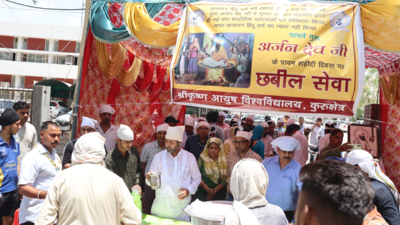
Shri Krishna Ayush University (SKAU) vice chancellor Prof Vaidya Kartar Singh Dhiman made a controversial statement on Monday that Guru Arjan Dev, the fifth Sikh Guru, sacrificed his life to protect Sanatan Hindu Dharma.On the occasion of Shahidi Diwas (martyrdom day) of Guru Arjan Dev, SKAU, a government Ayurveda university, organized Chhabeel (sweetwater langar) to remember him.

The banner placed by SKAU at Chhabeel counter shows a painting of atrocities being committed on Guru Arjan Dev and the description reads, “For protecting Sanatan Dharma, fifth Guru of Sikh Panth accepted the torture by Mughal invader Jahangir but did not abandon his Sanatan Dharma.”
SKAU also released a written statement of VC Dhiman said, “In the glorious history of Sanatan culture, the priceless thoughts of the fifth Guru of Sikh Panth, Sri Guru Arjan Dev Ji, inspire the entire human race to follow the right path. Throughout his life, he not only showed the light of knowledge to mankind, but also to protect the Sanatan Hindu Dharma, when the Mughal invader made him sit on a hot pan and hot sand was poured on his head, even then he did not abandon the Sanatan Hindu Dharma despite suffering physical torture.”
When contacted about the statement by SKAU VC, Haryana Sikh Gurdwara Management Committee’s Dharam Prachar (religious preaching) chairman, Baljit Singh Daduwal said, “Some Chaploos (sycophant) people try to please their masters in attempt to change and re-write Sikh history. Such people should refrain from doing so or the community would take decisions as per its Panthic traditions. The Sikh Sangat should also be aware and oppose such expressions.”
Delhi’s JAGO party chief Manjit Singh GK said, “The Sikh Gurus never adopted Sanatan Hindu Dharma ideology rather they brought their Sikhs out of superstitions and other such rituals. The sacrifice of Guru Arjan Dev Ji was because of his work that he compiled Guru Granth Sahib, such a Granth, which was revered by people of all three communities be it Hindu, Muslim or Sikhs.”
A social media post by Shiromani Gurdwara Parbandhak Committee (SGPC) posted on this occasion reads, “During his time as Guru, Guru Arjan Dev wrote Gurbani (holy verses), built Sri Harmandar Sahib (Golden Temple), compiled Guru Granth Sahib, developed towns (Tarn Taran and Kartarpur), developed Sarovars (Amritsar and Santokhsar in Amritsar) and wells and other great works, due to which Mughal rulers felt uneasy. The fifth Guru was martyred by Mughals under false charges of Yasa law.”
According to Sikh writer Kapur Singh, the Yasa law was utilized by the Mongols to execute religious figures. They believed that shedding the blood of such individuals would lead to their spirits returning to cause trouble. Although the Mongols later embraced Islam, they continued to adhere to the Yasa law. This explains why Guru Arjan Dev was subjected to torturous death without shedding his blood.
Following Akbar’s death in 1605, Jahangir ascended to the throne and felt uneasy about Guru’s growing popularity. He succumbed to the pressure exerted by Guru’s enemies. Various allegations were levied against Guru Arjan Dev, including his alleged support for the rebellious Khusro.
In the Jahangirnama, it is recorded, “He pretended to be a spiritual guide and deceived many gullible Indians, as well as some ignorant Muslims, by proclaiming himself a saint. They referred to him as Guru. Numerous naive individuals sought solace in him and unquestioningly believed in him. This charade had persisted for three or four generations. I had long contemplated whether to eradicate this false profession or to bring him into the fold of Islam. Eventually, when Khusraw passed through the region, this insignificant individual desired to pay homage to Khusraw. When Khusraw halted at his residence, [Arjan] emerged and engaged in conversation with [Khusraw], offering him rudimentary spiritual teachings gathered from various sources… When I was informed of this, I realized the extent of his deceit and ordered him to be brought to me. I assigned his properties, dwellings, and those of his children to Murtaza Khan, and commanded the confiscation of his belongings and goods, as well as his execution.”

About the Author
Jaskaran SinghEnd of Article
FOLLOW US ON SOCIAL MEDIA










Photostories
Hot Picks
TOP TRENDING
Popular Categories
Hot on the Web
Top Trends
Ratan TataRatan Tata HospitalisedIND vs BAN Live ScoreRatan Tata DiesNew UPI Transaction LimitWorld First Top 10 TrillionairesStock Market TodayKerala Lottery ResultElection Results 2024Tom BradyIsrael Hezbollah WarSuryakumar YadavManagement Colleges of IndiaTop Medical Colleges of IndiaTop Engineering Colleges of IndiaTop Pharmacy Colleges of IndiaLive Cricket Score
Trending Topics
Diwali WishesBigg Boss Tamil 8 Contestants ListBhool Bhulaiyaa 3 TrailerDurga Puja WishesSanjay Leela BhansaliVettaiyan ReviewBigg Boss 18 House PhotoDevara CollectionBigg Boss 18Deepika PadukoneShailesh LodhaDevaraColdplayNational Film Awards 2024Swatantrya Veer SavarkarColdplay India tour 2025Watch NFL Live StreamDress To ImpressRatan Tata DeathWordle Answer
Living and entertainment
Latest News
Ratan Naval Tata: The inspiring journey of Padma Vibhushan laureate and golden-hearted business tycoonSamantha Ruth Prabhu shares playtime with Chinmayi Sripaada's daughter, says 'It took her 4.5 seconds to disown her parents'Mohanlal remembers late TP Madhavan: ‘His love and affection were akin to that of a father towards me'Ratan Tata: The industry titan with a golden heartManifesting with the 10/10 Portal: Zodiac-based guide for 2024Only a true creative genius can spot the odd unicorn in 12 seconds!Indian man goes ‘skinny-dipping’ at an Australia's beach that isn’t even on Google Maps | Watch video"We all still love him": TNA producer and former Knockouts Champion hopes for AJ Styles’ return to the company"She's garbage": Raheem Mostert's Wife, Devon, Calls Out Kamala Harris Over Controversial Hurricane Milton RemarksAnupama's 15-year leap: Toshu's transformation and new actor Manish Nagdev joins amidst dramatic fire crisisAamir Khan takes Amitabh Bachchan back to his Kolkata days300 kg tea adulterated with coconut shell powder seized in this cityCan simple lifestyle changes really keep the flu at bay?Bigg Boss 18: Karan Veer Mehra opens up about losing his father at the age of 10; says 'Main apne dad ki death par nahi roya'Bron Breakker addresses his heel turn after this week's WWE RAWDaRon Bland’s Return: Could He Be the Key to Reviving the Cowboys’ Defense?Five Dabolim flights hit by rain re-routingRatan Tata passes away at 86: Tata Sons' complete statement
Copyright © 2024 Bennett, Coleman & Co. Ltd. All rights reserved. For reprint rights: Times Syndication Service