
- News
- Left loses ground among workers in garments hub of Tirupur
This story is from May 6, 2016
Left loses ground among workers in garments hub of Tirupur
Soundar has lived in Tirupur ever since his father, originally a weaver, moved to the garment manufacturing town to get a job in a factory. When he was in his teens, Soundar joined one of the many garments factories and now works as a pattern designer, but little has changed since his father left the loom for a factory job five decades ago. “My lifestyle and living conditions are just as poor as his were,“ says Soundar.
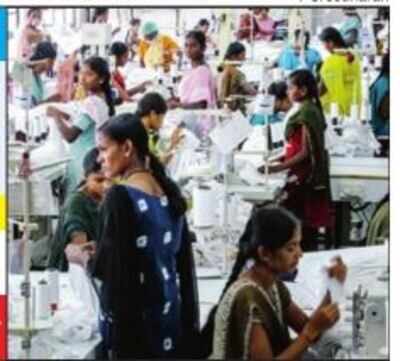
With elections around the corner, thousands of garment workers in Tirupur, which accounts for 75% of India's garments exports, are hoping candidates will look into their demands -better housing, higher wages and an ESI hospital.
Tirupur's garment factories employ five lakh workers, of which about a lakh are from Bihar, Odisha and other northern states. About 2.5 lakh workers are from the southern districts of Tamil Nadu, while 70,000 to 80,000 workers are from Tirupur. “ And 90% of them are homeless or live in 10x10 rooms,“ said G Sampath, general secretary of Baniyan and Pothu Thozhilalar Sangam, a workers' union.“Since migrant workers do not demand higher wages, the local garment workers also suffer,“ said Sampath.“The government must build housing for workers.“
From the 1950s to the 1980s, vests manufactured in Tirupur were sold in the domestic market. By 1984, manu facturers began exporting goods, and by 1990, it became the dollar city . As the demand for yarn and garments rose, so did the number of workers and factories but not the conditions of work.
Initially , the workers were associated with trade unions such as CITU and AITUC. “Earlier, only the Left and Congress fielded candidates.
Most of us voted for Communist candidates. When DMK was formed, Congress lost its small support base.But it is the Communist parties that hold sway ,“ said P Balan, a retired garment worker. The sitting MLA of Tirupur South is CPM's Thangavel, who is defending his constituency this time.
Trade unions, however, have lost their hold over the last decade,weakened by Central government policies. “People from various districts be gan coming Tirupur and unions could not unite them all. Introduction of technology weakened trade unions further,“ said Kalidas, a designer.
Aravind S, a factory owner, said the Left won seats only because they allied with AIADMK, which continued to benefit from MGR magic. “The Left has never won a majority on its own,“ he said.
The general opinion is that Tirupur is self-reliant and self-sustaining.“All the current factory owners were once labourers. I started my career as a tailor in a factory,“ said K Subramanian, a garment factory owner. “Tirupur has never been dependent on political parties or governments for development. Whatever Tirupur is today is because of the hard work of its people.“
End of Article
FOLLOW US ON SOCIAL MEDIA

Hot Picks
TOP TRENDING
Popular Categories
Hot on the Web
Top Trends
Trending Topics
Devara CollectionBigg Boss Kannada 11 Launch Live UpdatePawan KalyanJungle SafariStree 2 OTT ReleaseRose GardenDevara CollectionOTT Release MovieMasala OmeletteEmergencyDevaraTaaza Khabar 2 Twitter ReviewDevara Movie ReviewHealthy RaitasSwatantrya Veer SavarkarColdplay India tour 2025Smartphone DealsApple Macbook Air M1Amazon SaleWordle Answer
Living and entertainment
Latest News
TN: Sri Lankan Navy apprehends 17 fishermen off Rameswaram coast, seizes 2 boatsIndia shooter reports late for final, misses potential medal at Junior World ChampionshipsExclusive - A sneak peek into Zain Imam aka Teerth’s makeup room on the set of Suman IndoriTumbbad re-release box office: The Sohum Shah starrer mints Rs 95 lakhs on third SaturdayAir Arabia launches early bird promotion on 500,000 seats from INR 5,727!‘Devara’ stars Jr. NTR and Saif Ali Khan try their hand at Punjabi and BhojpuriAir Canada fined for breaching restricted Iraqi airspace"Is Taylor Swift Gonna Be in the Stands for the Chiefs vs. Chargers Showdown?"Stress could be your heart's worst enemyI Say ‘Khamosh’ to Sonakshi: Zaheer Iqbal - ExclusiveHost Kiccha Sudeep to Bigg Boss Kannada 11 contestant Aishwarya Shindogi: Come back as a stronger personKhatron Ke Khiladi 14 winner: Karan Veer Mehra lifts the trophy and Krishna Shroff becomes the first runner-upWhat to expect after a facelift procedureColleagues remember braveheart Delhi Police constable Sandeep: 'Would rush to crime scene alone'Baloch Human Rights slam Pakistan and China, call it 'a failed state'With $3.16 Million Lost in Game Checks, Can Haason Reddick Afford to Keep Holding Out?Haryana polls: Explain the 'compelling' circumstances, CEO asks authorities on Dera Sacha Sauda chief Ram Rahim's plea for temporary releaseUnion minister Nitin Gadkari invites Sachin Tendulkar for coffee at newly inaugurated bird park in Maharashtra's Jamtha
Copyright © 2024 Bennett, Coleman & Co. Ltd. All rights reserved. For reprint rights: Times Syndication Service