
Trending
This story is from February 16, 2020
IAF jeep near runway forces early takeoff at Pune airport, AI plane damaged
The pilots of an Air India flight (AI-852) to Delhi with 180 passengers onboard resorted to a steep take-off at Pune airport on Saturday morning after spotting a jeep and a man on the edge of the runway.
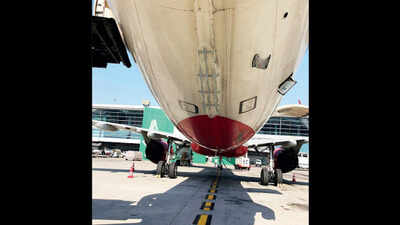
During inspection of the aircraft in Delhi, it was found that the plane suffered a tail strike
The aircraft — an Airbus A321 — was hurtling at a speed of 222kmph when an alert Captain Vikram Singh Besoa and First Officer Mansika Harlan spotted them and decided to go for early rotation — lifting nose wheel off the ground — instead of completing the take off roll as planned before doing so.

The Pune airport director, Kuldeep Singh, confirmed that the pilot of the aircraft had spotted a jeep on edge of the runway during the course of the take-off and reported it to the Air Traffic Control (ATC). “The ATC acknowledged the message of the pilot,” he told TOI.
Singh said, “The flight was taking off from Pune at 8.05am. The ATC and the runway of the Pune airport is managed by the Indian Air Force (IAF) and the Airports Authority of India doesn’t have jurisdiction there. The jeep in question belongs to the IAF, which has its own mechanism to manage the runway, and it will conduct an investigation.”
He said, “The pilot, after landing in Delhi, reported the matter to the Directorate General of Civil Aviation (DGCA), which will also investigate the matter,” Singh said.
DGCA, IAF launch probe after tail-strike at airport
As per protocol, the crew has been taken off flying duty so that they are available for the investigation. “We will have an interaction with them shortly. The IAF has been requested to preserve ATC recording for the investigation,” said a DGCA official.
IAF spokesperson Group Captain Anupam Banerjee told TOI over the phone from New Delhi, “On February 15, during the morning hours, a service vehicle was cleared for routine task on the runway at Pune Airfield. It reached close to the runway at a time when an Air India flight was on the take-off roll. Due to the presence of the vehicle near the runway, the Air India pilot had to do an earlier rotation than what was planned by the crew of the aircraft. The matter is under investigation by IAF.”
Dhananjay Kumar, the spokesperson of Air India, said, “The A321 aircraft was scheduled to operate as AI 825 to Srinagar, but certain marks were observed towards the empennage area. This aircraft arrived from Pune as AI-852 and it has been withdrawn for detailed investigation. The cockpit voice recorder (CVR) and solid-state flight data recorder (SSFDR) readouts would be carried out and the findings would be shared appropriately.”
A source said the damage to the aircraft was the result of it scraping either against the jeep or the runway during the steep take-off in Pune.
“The aircraft was hurtling on the runway at a speed of 222km per hour (120 knots) when the pilots noticed the jeep on the edge of the runway in Pune. After attaining that speed, the take-off couldn’t have been aborted as that would have resulted in an accident,” a source at the city airport said.
Another source in the airport said, “The runway of the airport is closed from 8am to 10.30am from Sunday to Friday for IAF’s practice sessions. On Saturdays, the runway is shut down from 11am to 5.30pm for maintenance. Some outer peripheral work pertaining to the runway re-carpeting is also taking place in the apron area at present. The IAF carries out the runway maintenance works.”
Aviation analyst and expert Dhairyashil Vandekar said the quick thinking of the pilots saved the day. “As per our understanding, the pilots did a very good job and their quick thinking prevented a disaster from happening. They were at a very high speed and abandoning the take-off could have led to serious consequences. It must have been a high-pressure situation for them. The aircraft was rolling at 120 knots and his decision to take-off has to be applauded,” Vandekar said.
He also said, “The fact that a jeep came on the edge of the runway when the aircraft was rolling at a high speed itself is a very big lapse. It is the duty of the ATC to ensure that the runway is cleared before it permits an aircraft to take off. For that, standard procedure, including telling all vehicles and people to move away, is followed.”
(With inputs from Sandip Dighe)
End of Article
FOLLOW US ON SOCIAL MEDIA






Hot Picks
TOP TRENDING
Trending Stories
In City
Entire Website
- 'Osama's 'dead son' is alive, leading al-Qaida in Afghanistan and has terrifying plans'
- Diljit Dosanjh’s Dil-Luminati India Tour: Check dates, venue, how to book concert tickets online
- Hamster Kombat Daily Cipher Codes and Combo Cards for September 13, 2024: Unlock up to 1 million coins
- Narayana Murthy faces backlash for parenting remarks on social media; users say, "after working 72 hours a week, there’s barely time left to have babies…”
- Shreyas Iyer comes out to bat wearing sunglasses, falls for a duck in Duleep Trophy
- iPhone 16 will be available for Rs 54,900 on Apple website; here's how you can grab the deal
- iPhone 16 to go on pre-order today: Pre-booking details, time, sale date and more
- Vande Metro launch date, schedule: PM Modi to flag off Bhuj-Ahmedabad Vande Metro train; check timings, stoppages of new Indian Railways train
- Why around 40,000 TCS employees have received tax demand notices for Rs 50,000 to over Rs 1 lakh
- Bill meant to usurp Waqf land, JPC told
- Despite debate win, Kamala Harris makes no dent in battleground states
- 2 Army soldiers killed in ongoing encounter in J&K's Kishtwar
- 'I was molested in ambulance in which my husband was fighting for life'
- 'Osama's 'dead son' is alive, leading al-Qaida and has terrifying plans'
- Sunita Williams, Butch Wilmore to vote for US election from Space: 'Very important duty'
- Preschools turn nursing homes, retirement age raised: China's demographic crisis explodes
- Are drone and rocket attacks the new normal in Manipur?
- Jhumka Gira Re ...: American woman's Instagram post on India goes viral
- Assam CM reveals how his 'doubt' unearthed multi-crore trading scam
- Vande Metro first look: Top 10 features of new train for common man

Popular Categories
Hot on the Web
Top Trends
Shannon Sharpes Net WorthVande MetroAadhaar Card UpdateTech LayoffsArvind Kejriwal BailShannon SharpeUPSC Mains Admit CardKristina JoksimovicTCS Employee Tax NoticesWay Chatgpt can be your Study PartnerAir Taxi IndiaAyushman Bharat SchemeKolkata Doctor Rape CaseDonald TrumpShreyas IyerDiljit DosanjhLive Cricket Score
Trending Topics
Alia BhattMalaika Arora Father DeathArbaaz KhanNatasa StankovicMr Bachchan OTT ReleaseNational Parks In IndiaSelena GomezGOAT CollectionVikas Sethi DeathMalayalam ProducersIndia's Best Dancer 4Simi GarewalDilli BabuIndian National ParksLaung BenefitsVikas SethiApple iPhone 16SpaceXAadhar Card Update By Sept 14Wordle Answer
Living and entertainment
Latest News
7. Hindi becomes officialKitchen Tips: How to elevate home cooking to Michelin levelJulie Chen to miss Big Brother live eviction for first time, taps Jerry O'Connell to hostTragic road accident on Mogili ghat road claims seven lives in Chittoor districtRaveena Tandon apologizes to fans for not photo snub in London: "It was not my intention to offend"Bonedi baris hope for a peaceful start to PujoPreschools turn nursing homes, retirement age raised: China's demographic crisis explodesTovino Thomas praises Prithviraj Sukumaran as director: "One of the brilliant directors I have ever worked with"Man shot near Delhi's Greater Kailash-I gym, gang war suspected'Cops stood as mute spectators': Protesting doctors write to President over RG Kar impasseFatal crash in Australia's Netherby claims life of ToddlerNASA to establish New Lunar Time Standard with Coordinated Lunar Time (LTC) initiativeDivya Bansal explores themes of human resilience, love and positive transformation in debut poetry bookWWE Superstar Cody Rhodes and his Wife Brandi Rhodes Share Special Messages on Their 11th AnniversaryAnupamaa: Anuj and Anu to go legal against Ankush and Barkha'Dead cat hanging from a tree': Origin of Haitian immigrants row. Everyone heard itTop 5 least private zodiac signsPerfect comfort foods for every zodiac sign
Copyright © 2024 Bennett, Coleman & Co. Ltd. All rights reserved. For reprint rights: Times Syndication Service