
- News
- City News
- nagpur News
- Over 1,000km journey for ₹100 a kg, tomatoes land consumers in a soup
Trending
This story is from June 29, 2023
Over 1,000km journey for ₹100 a kg, tomatoes land consumers in a soup


“These places are 500km away even from Hyderabad. Truckloads of tomatoes come from such centres in Andhra or Karnataka supplying to markets like Durg or Rajnandgaon in Chhattisgarh, Gondia in Maharashtra, finally reaching Nagpur before going further ahead,” says Nandkishore Gaur of the Nagpur Vegetable Merchants Association.
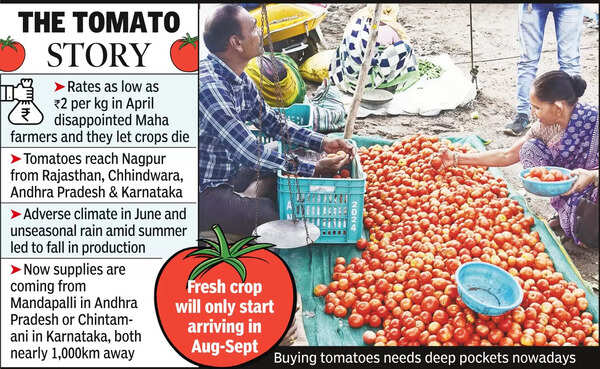
Farmers in the southern states would be soon sowing fresh crop. The supplies may only ease after that. The rates are expected to be high at least for a month, says Vinod Bhaise, the association’s president. Though the fresh crop will only begin arriving in August-September, say traders.
Supplies come from Nashik and Sambhajinagar too. But dismayed by the sharp dip in the rates in April, farmers in Maharashtra decided to neglect the standing crops which drastically reduced the supplies from within Maharashtra. Adverse climatic conditions like dry spell in June and unseasonal rain amid summer are also being attributed to the fall in production.
The desi tomato used for direct cooking comes from these areas. Another variety used to make soups and salad comes from Nashik, say traders.
Bhaise also says that supply from other states is over and the climate has affected production leading to rate increase.
Not much tomato is grown in the region due to hot climatic conditions. Apart from some locally grown crop, bulk traders depend on long distance supplies. Tomatoes reach Nagpur from Jaipur in Rajasthan, neighbouring Chhindwara, Andhra, Karnataka to even Nashik, and Sambhajinagar in the state. The supplies from each centres are cyclical. With arrivals drying up from the other centres the only reliable source of supply for Nagpur is from down south, say the traders.
Although the season is over in other centres, there is some amount of supplies which remain. This year there is hardly any arrival from area other than the southern states, says Gaur. There have been changes in weather but the crop in south has not been impacted much, he says.
Shankar Dikhley, a farmer from Nashik, said the rates touching as low as Rs2 a kg in April disappointed farmers and a large number of them gave up on the maintenance of the standing crop. The production could have been maintained by proper spraying of pesticides and other methods. But the farmers thought it would not be possible to even recover the expenses. In the end, many of them left the crop for the sheep to graze,’ said Dikhley.
End of Article
FOLLOW US ON SOCIAL MEDIA







Hot Picks
TOP TRENDING
Trending Stories
In City
Entire Website
- UPI transaction limit to change from September 16! Here are the new limits for various UPI payments
- GK for students: 7 Fascinating Features of These Unique Birds
- No look shot gone wrong! Pakistan batter hilariously trolled after dismissal. Watch
- Andhra suspends 3 IPS officers for 'framing', arresting Mumbai actress
- UP medical aspirants converting religion to secure MBBS seats: A look at NEET UG admission criteria around minority reservation rules
- Who is Ryan Wesley Routh? Man held for 'apparent assassination attempt' on Trump
- Virat Kohli at his destructive best, shatters Chepauk wall near India dressing room with six
- 'Prince Harry is not even the spare to his wife': Meghan Markle’s treatment of Duke under fire
- Vince McMahon’s Expensive Properties, Bungalows, Villas, Private Jet, Car Collections, and More
- "Miami Dolphins Owner Stephen Ross Eyes Multi-Billion Dollar Deal: The $7 Billion Power Play"
- Assassination bid on Trump: 'Gunman supporter of Ukraine in its war against Russia'
- 'Doesn't sound like the man I know:' Son of assassination attempt accused
- Cow vigilantes killing a Brahmin is the wake-up call India needed
- 'Didn't want to be late for party': BMW speeding down wrong lane kills 2
- 15 phones, knives, omelette stoves found in 'relaxing' prison of Darshan
- Who is Ryan Routh? Man held for 'apparent assassination attempt' on Trump
- Will resignation gambit help Kejriwal win Delhi again?
- Apple's biggest 'iPhone update' for 2024: India time, how to prepare
- 13-year-old sets world record with 800 kg millet portrait of PM Modi
- 'He may have said so, but ...': Pradhan reacts to Anil Vij’s CM claim

Popular Categories
Hot on the Web
Top Trends
Trending Topics
Living and entertainment
Latest News
Challenges won’t stop me from making films that matter: Aditya Kripalani3 Reasons Why Hell in a Cell Tag Team Match Between Cody Rhodes, Roman Reigns and The Bloodline 2.0 Would Be perfect for Bad Blood 2024Odisha to join Ayushman plan; Delhi, Bengal to be only holdoutsRobert's wild encounter with Henry, the world's oldest 124-year old crocodile; internet shocked | Watch videoHooda says Congress coming to power in Haryana, asks criminals to give up crime or leave state‘I Hate Taylor Swift!’: Donald Trump rages after singer endorses Kamala HarrisFather-son duo Eugene and Dan Levy's dazzling entrance at the EmmysBakuchiol: Nature’s answer to youthful skin radianceSaudi Arabia footballer Fahad Al-Muwallad hospitalized after fall from balcony'Will hug my kids extra tight tonight': JD Vance after Trump 'assassination attempt'Bengal govt blames junior docs for logjam but sends fresh offer for talksLodi-era mosque collapses in AgraVineet Kumar Singh calls Superboys of Malegaon standing ovation at TIFF a 'magical experience': 'I can still hear the clapping and whistling" - ExclusiveFoods to pair with dates for boosting immunityLast Lunar Eclipse of 2024: What it means for your zodiac signNeeraj Chopra misses second Diamond League title by an agonising 1 cm; finishes second behind AndersonKejriwal says he will quit as CM in 2 days, wants aam aadmi's 'honesty certificate'Jessica Gunning wins her 1st Primetime Emmy for 'Baby Reindeer'
Copyright © 2024 Bennett, Coleman & Co. Ltd. All rights reserved. For reprint rights: Times Syndication Service