
- News
- City News
- kolkata News
- On a tiger’s tail
Trending
This story is from March 10, 2018
On a tiger’s tail
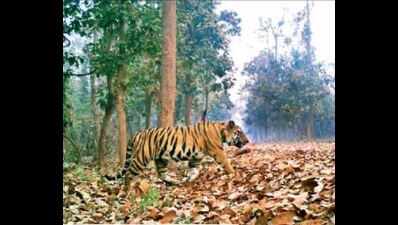
While cameras keep an eye on the forest in the ground, drones scan it from above. As the tiger, a full-grown male, skirts foresters’ attempts to track or capture it, conservationists are asking a key question: tiger habitats in India are protected, but are they connected?
In an earlier interview to TOI, conservation filmmaker Krishnendu Bose, whose film ‘The Tiger Who Crossed the Line’ won the National Award last year for best environmental film, had said: “P K Sen, the then project tiger secretary, said in a Films Division documentary circa 1995 that half of Indian tigers live outside protected areas.

The Lalgarh tiger, one among the hundreds of such “homeless tigers” of India (the 2014 tiger estimation exercise had revealed at least 40% of more than 2,000 wild tigers in India live outside protected areas), thus represents the shrinking forest corridors that connect two or more protected tiger habitats and also undermines the need to safeguard them.
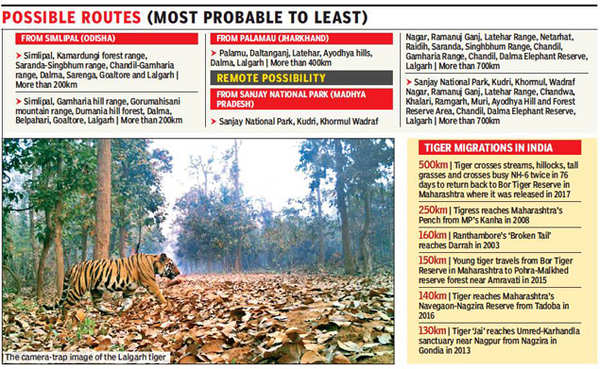
With most major tigers reserves in India having reached carrying capacity, big cats are often forced to leave the protected areas in search of prey and mates. And, even as speculation is rife about the Lalgarh tiger’s origin — is it from Odisha’s Simlipal, the nearest tiger habitat more than 200km away, or from Jharkhand’s
Palamau, more than 400km away? — conservationists believe that foresters shouldn’t waste a moment to rehabilitate it in a suitable habitat if it’s captured.
Longest migration?
So, how far do tigers actually travel, whether in search of a mate or prey? Quite a distance, say experts and available data. A tigress captured from the buffer of Maharashtra’s Tadoba and released in Bor Tiger Reserve, in the same state, in 2017 had crossed hillocks, streams, tall grasses and the busy NH-6 twice in 76 days to return to the site of its release. In the process, it had travelled more than 500km. “Tigers are great wanderers and can come from nowhere,” says Belinda Wright, conservationist and executive director of Wildlife Protection Society of India.
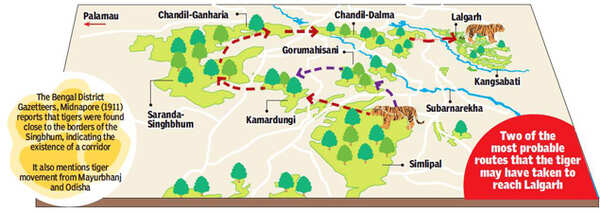
The nearest tiger habitat being Simlipal, it is being surmised that the tiger most probably could have come from there. “From Simlipal, a tiger can take the green patches and last remaining forest corridors of Kamardungi, Saranda-Singbhum, Chandil-Gamharia, Dalma, Bankura’s Sarenga and Midnapore’s Goaltore to finally reach Lalgarh after crossing the Kangsabati river,” says Ratul Saha, WWF-India’s Sunderbans chapter head, whose team had laid the camera traps in Lalgarh. On this route, the tiger would have had to travel more than 200km.
The tiger’s stripe pattern, incidentally, hasn’t matched the patterns of the around 10-12 Simlipal tigers whose photos currently exist in the database of the National Tiger Conservation Authority (NTCA). This, however, doesn’t rule out the possibility that it came from Simlipal. “It could still be a tiger from Simlipal — one that hadn’t been picked by any camera there. It could also be from any wildlife sanctuary or reserve forest here, where cameras had never been installed,” says Biswajit Mohanty, an Odisha-based conservationist and former member, National Board for Wildlife.
There’s no corridor for tigers to travel beyond the Hadgarh Wildlife Sanctuary to the south-west of Simlipal, says Mohanty. “But the connectivity with corridors is better to the north-east of the park,” he adds.
A source, however, informs that these corridors are mostly fragmented, and a tiger would have to cross two big rivers (Subarnarekha and Kangsabati), not to mention the busy NH-6, to reach Lalgarh via Nayagram after travelling almost 250km.
“But, to a tiger, this distance is nothing,” Mohanty adds. “A big cat from Satkosia had travelled more than 150km to Nandankanan a few years ago.”
State chief wildlife warden Ravi Kant Sinha, though, said they were not ruling out Jharkhand’s Palamau — more than 400km from Lalgarh — as the big cat’s possible origin since it’s better connected to this part through forest corridors like Dalma.
History take
Has there ever been any tiger in Lalgarh?
The “carnivora of Midnapore was then represented by tiger, leopard, bear, hyena, foxes and jackals among others”, according to a 1911 report in the ‘Bengal District Gazetteers, Midnapore’, by LSS O’Malley.
“The carnivora was mostly found in western part of the district where there’s Sal forest. Before the opening of the district by the railways, destruction of forest and extension of cultivation, tigers were also seen in the eastern alluvial portion of the district, especially near the mouths of Haldi and other rivers,” the report says.
Referring to it, Saha says tigers were also found close to the borders of Singbhum, indicating the existence of a corridor at that time.
Also, there are mentions about tiger movement from Mayurbhanj, a princely state, and Odisha. The gazetteer also mentions the shooting of a tiger near Nayagram. O’Malley, in the journal, referred to tigers and leopards as “occasional visitors from the Sundarbans or from the western jungles”.
The Road Ahead
In his 1911 journal, O’Malley had sounded the alarm over hunting of prey species by tribals. More than a century later, his fears have turned true.
With no proper prey base for the tiger and the big cat killing at least seven full-grown cows in Lalgarh since it was sighted for the first time on February 1, foresters have decided to capture and shift it to the Jharkhali rescue centre in the Sunderbans.
While options are also being explored to reintroduce it in a suitable north Bengal habitat after capture, it has raised the hackles of conservationists. “If it’s a healthy tiger, no time should be lost in releasing it in a suitable habitat. It should have its senses sharp... it shouldn’t get used to human presence or food being served on a platter,” Wright cautions.
World Animal Protection also issued a statement: “There is some discussion that the tiger will be taken to a rescue centre for captive tigers in Jharkhali. If possible the animal should be returned to the wild and not to the stressful confines of captivity.”
End of Article
FOLLOW US ON SOCIAL MEDIA







Hot Picks
TOP TRENDING
Trending Stories
In City
Entire Website
- 9/11 Remembrance Day: Key moments from the deadliest attack on US
- Howard University: 10 landmark firsts of the institution that shaped Kamala Harris
- Earthquake of magnitude 5.8 strikes Pakistan, tremors felt in Delhi, neighbouring areas
- Who were Barack Obama's challengers in 2008 and 2012 US presidential elections?
- 'A in INDIA alliance': Rahul Gandhi's slip-up during address to Indian-Americans goes viral
- Trump vs Harris: Betting markets reveal who’s expected to win the US presidential debate
- IGNOU December 2024 Term-End Exam: Registration Details, Important Dates, and Fee Structure
- Top 10 TED Talks to Boost Confidence and Success for Female Students
- Case against British Indian woman for Hindu prayers on beach collapses
- China refuses to sign agreement to ban AI from controlling nuclear weapons
- Tussle in Mahayuti: Total seats 288, but BJP wants 160, Shiv Sena 100+ and NCP 60+
- ACT Hockey: India hammer Malaysia 8-1
- Why is Kolkata rape-murder victim’s mother accusing Mamata of lying?
- 'Openly working against India': BJP slams Rahul over 'anti-national' remarks
- Kolkata rape-murder: Bengal govt invites agitating doctors for talks at 6pm
- An Indian, not Columbus, found America, says MP education minister
- What Apple's latest iPhones with built-in AI mean for us
- iPhone 16 series launched: Complete features, price and how to pre-order
- Malaika Arora's father Anil Arora dies by suicide
- Encounter breaks out between security forces and terrorists in Udhampur

Popular Categories
Hot on the Web
Top Trends
Trending Topics
Deepika PadukoneMalaika Arora Father DeathArbaaz KhanJayram RaviAishwarya Rai BachchanSlat WaterWeight GainGOAT CollectionVikas Sethi DeathMalayalam ProducersIndia's Best Dancer 4Simi GarewalDilli BabuIndian National ParksLaung BenefitsVikas SethiiPhone 16Dubai Princess Sheikha MahraMG Windsor EvWordle Answer
Living and entertainment
Latest News
Manju Warrier expresses gratitude for birthday wishes: "Forever humbled and grateful"Haryana HPSC PGT admit card 2024 out at hpsc.gov.in: Direct link to download hall ticket here6,0,6,6,6 - Smashing Kieron Pollard rolls back the clock in Caribbean Premier League - WatchRelief for Amul in trademark war against Italian brandAfghanistan vs New Zealand: Why is Greater Noida stadium hosting a Test match?Shilpa Shetty and Raj Kundra spotted at the Siddhivinayak Temple; video insideDonald Trump and Kamala Harris shake hands as they meet for first time on debate stage: Watch the 'awkward' momentPrince William’s commitment to a lasting marriage with KateWhen Jaya Bachchan revealed she had a huge crush on Dharmendra, called him a 'Greek God' in front of Hema MaliniJr NTR starrer 'Devara: Part 1' completes censorship formalities; receives UA certificateGeorgia school shooting: Suspect's mom's call wasn't the only alert, multiple warnings overlooked before Apalachee high attack'Trump should not be telling a woman what to do with her body', says Kamala Harris on abortion rights during US presidential debateArbaaz Khan spotted outside Malaika Arora's house along with police after the tragic news of her father's demise by alleged suicide - WATCH VIDEOShivaji statue collapse: Sculptor’s custody extended till September 13Vijay Sethupathi and Trisha starrer '96' to have a sequel, reveals Prem Kumar7 Common veggies that are loaded with iron and essential nutrientsAir India Express and Scoot launch exciting flight sale for domestic and international travelBengaluru techie pockets 1k cryptocurrencies of his company, lands in police net
Copyright © 2024 Bennett, Coleman & Co. Ltd. All rights reserved. For reprint rights: Times Syndication Service