
- News
- City News
- jaipur News
- 90% of Rajasthan to get connected with surface water by 2026
Trending
This story is from June 29, 2023
90% of Rajasthan to get connected with surface water by 2026
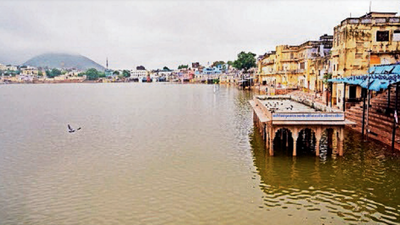
Pushkar Lake’s water levels rise after heavy rainfall last week.
Engineers of Public Health and Engineering Department (PHED) said that even in 2019, just before JJM was implemented, only 50% places of the state were connected with surface water, making Rajasthan one of the largest dependents on groundwater among the states of India.

“In the last four years, the state government has approved 33 surface water projects. If everything works fine, we are going to complete all these projects by 2026. Once they are completed, 90% areas in Rajasthan would get connected with surface water,” said PHED chief engineer (special projects) Dinesh Goyal.
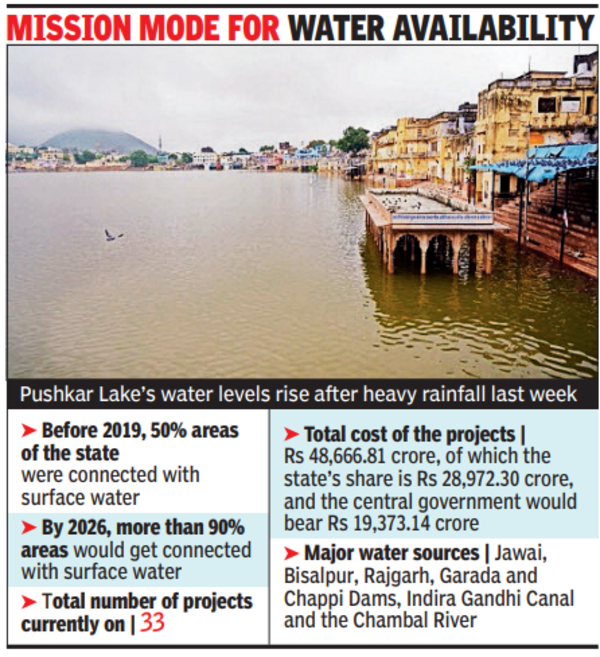
These 33 projects together would cost Rs 48,666.81 crore, of which the state’s share is Rs 28,972.30 crore while the central government would bear Rs 19,373.14 crore, said PHED officials.
Out of the 10% of the state’s areas that would still have to depend on groundwater, 5% comprise portions of Alwar district and the neighbouring areas of Jaipur district. The remaining 5% are pockets in the districts of Sirohi, Udaipur, Banswara, Pali and a portion of
Sri Ganganagar district.
While implementing the connections under JJM, PHED had formed a committee to determine the quantity of groundwater available in every district and the water sources that would sustain for a few years, said officials. The committee reported that these areas of Sirohi, Udaipur, Banswara, Pali and Sri Ganganagar can sustain on their groundwater source for some years, they added.
“However, for areas of Alwar and Jaipur district we have to switch to surface water. Eastern Rajasthan Canal Project (ERCP) would solve the problem. But it has been delayed due to clearances from the central government,” said Goyal.
Officials said that besides reducing dependence on ground water, the projects would actually improve the drinking water quality in the areas getting connected with surface water. “Recently the chemists of PHED had compiled a report of water quality in urban areas of Rajasthan. This repot states that in a few towns and cities water quality remains unpotable. All these towns and cities consume ground water,” said an official.

About the Author
Arpit BasuEnd of Article
FOLLOW US ON SOCIAL MEDIA





Hot Picks
TOP TRENDING
Trending Stories
In City
Entire Website
- Centre seeks review of SC's mineral royalty judgment
- 'At 2:30 in the night, Rohit Sharma texted me and asked...'
- Schools closed across various states till 16th September: Here’s why
- Live wire snaps, boy recalls science lesson, saves lives with sister
- Many parts of Chennai face power supply disruption due to fire at Manali substation
- Aadhaar card update: Do you have to compulsorily update details on your Aadhaar every 10 years?
- Kevin Spacey allegedly demands $100,000 to vacate Baltimore residence, new owner says actor tries to 'paint himself as victim’
- Who is Jared Isaacman? Billionaire who stepped out of SpaceX capsule for first private spacewalk
- NMC approves expansion: GMC to offer 200 MBBS seats and more PG seats in 2024-25
- Veteran CPM leader Sitaram Yechury passes away
- 'BJP, using ED and CBI like its tota-maina': Sisodia after SC grants bail to Kejriwal
- 'Can't attend office': SC's bail conditions for Delhi CM Kejriwal
- ‘Illegal’ mosque or political agenda? Why’s there a new fire in Himachal?
- 'Stopped taking calls': Mayawati & Akhilesh blame each other for BSP-SP split
- Shreyas Iyer bats wearing sunglasses, falls for duck
- Hindu groups protest against illegal construction at Mandi mosque
- Sebi’s Madhabi Puri says she always does the right thing. Does she?
- Refund on iPhone 15 & 14: Apple's policy says conditions applied
- Karnataka's night of chaos: Mob plunders 25 shops, sets stolen vehicles on fire
- 'Rohit, Virat, Pant going to be the 'three' ... '

Popular Categories
Hot on the Web
Top Trends
Trending Topics
Alia BhattMalaika Arora Father DeathArbaaz KhanNatasa StankovicMr Bachchan OTT ReleaseNational Parks In IndiaSelena GomezGOAT CollectionVikas Sethi DeathMalayalam ProducersIndia's Best Dancer 4Simi GarewalDilli BabuIndian National ParksLaung BenefitsVikas SethiApple iPhone 16SpaceXAadhar Card Update By Sept 14Wordle Answer
Living and entertainment
Latest News
Fintech Moneyview turns unicorn, 6th one this yearSalman Khan surrounded by bodyguards as he arrives at Malaika Arora's mother's house to offer his condolences - WATCHJulie Chen to miss Big Brother live eviction for first time, taps Jerry O'Connell to hostBonedi baris hope for a peaceful start to PujoNIA raids pro-Khalistan preacher Amritpal Singh's relative's house in AmritsarA vision unfolds: How Levitation is crafting tomorrow’s enterprise solutionsTragedy strikes at fundraiser: Mother of two dies after marshmallow-eating competitionMan shot near Delhi's Greater Kailash-I gym, gang war suspected8 animals that reproduce without matingHow a balanced pH helps maintain your skin’s youthful appearanceStree 2 box office collection: Shraddha Kapoor and Rajkummar Rao starrer clocks Rs 539 croreISL-11 opener: Familiar foes back in businessBiden to host fourth quad summit with PM Modi, Albanese, and Kishida in Delaware on September 21: White HouseSanthy Balachandran turns screenwriter for Kalyani Priyadarshan and Naslen starrerFinancial graft probe against Sandip Ghosh: ED raids in Chinar Park, Tala & Kalindi in KolkataZodiac signs: What they regret and whyTecno Pova 6 Neo 5G phone announced in India: Price, features and other detailsNurse mutilates doctor's private parts, escapes rape bid
Copyright © 2024 Bennett, Coleman & Co. Ltd. All rights reserved. For reprint rights: Times Syndication Service