
- News
- City News
- gurgaon News
- Green walls along roads: How Gurgaon and Faridabad plan to fight dust pollution
Trending
This story is from February 14, 2023
Green walls along roads: How Gurgaon and Faridabad plan to fight dust pollution
To abate the impact of dust pollutants, the forest department is planning to develop green envelopes along roadsides in Gurgaon and Faridabad. A proposal for landscaping at least one stretch in each of the two districts during the upcoming plantation season has been sent to Chandigarh, officials said.
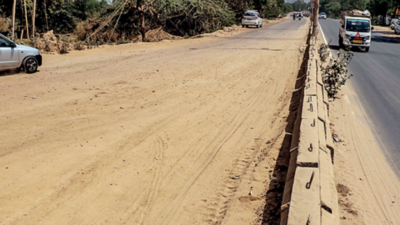
A proposal for landscaping at least one stretch in each of the two districts during the upcoming plantation season has been sent to Chandigarh, officials said.
“We want to start greening roadside belts to mitigate dust pollution.

Track the pollution level in your city
The two National Capital Region (NCR) districts, which over the years have topped the pollution charts in the country, have been struggling to introduce dust management measures. While civic agencies have been working towards identifying road dust hotspots and introduced mechanical sweeping, sprinkling and scientific disposal of collected waste, experts claimed that forest sinks were vital in mitigating dust pollution. Due to space constraints, they pointed out, green walls and similar structures should be promoted in urban areas. These, they claim, can help address more specific local problems of informal sources of pollution, fugitive emissions from small-scale units, open burning of waste and dust generation.
Unpaved and broken roads with no greening are the main contributors to dust pollution in the region, said Shubhansh Tiwari, a research associate at Amity Centre for Air Pollution Control. “Greening of road sidewalks, therefore, can be ideal in controlling dust pollution in the region,” he said.
As per the latest source apportionment studies for particulate matter, the dust potential of the construction sector and other associated sources was responsible for up to 41 per cent of PM10 generation in Delhi. Though a similar database is not available for Gurgaon and Faridabad, but as the two districts fall in the same airshed, their PM10 contribution of dust is likely to be in the same range.
The Haryana State Pollution Control Board (HSPCB) is also working on converting six pollution hotspots in Gurgaon into green ones. In Gurgaon, the six hotspots include Sector 86, Udyog Vihar Phase 1 to 2, Udyog Vihar Phase 3, Udyog Vihar Phase 4 to 5, Behrampur Road and Dwarka Expressway Sectors 110, 111 and 112. These hotspots, as per the board, have issues like unpaved roads, road patches and potholes causing dust emission and air pollution. The remedial measures will be taken by the local authorities including the civic body, HSIIDC, police, NHAI, forest department, MCM and GMDA.
End of Article
FOLLOW US ON SOCIAL MEDIA






Hot Picks
TOP TRENDING
Trending Stories
In City
Entire Website
- Centre seeks review of SC's mineral royalty judgment
- 'At 2:30 in the night, Rohit Sharma texted me and asked...'
- Schools closed across various states till 16th September: Here’s why
- Live wire snaps, boy recalls science lesson, saves lives with sister
- Many parts of Chennai face power supply disruption due to fire at Manali substation
- Aadhaar card update: Do you have to compulsorily update details on your Aadhaar every 10 years?
- Kevin Spacey allegedly demands $100,000 to vacate Baltimore residence, new owner says actor tries to 'paint himself as victim’
- Who is Jared Isaacman? Billionaire who stepped out of SpaceX capsule for first private spacewalk
- NMC approves expansion: GMC to offer 200 MBBS seats and more PG seats in 2024-25
- Veteran CPM leader Sitaram Yechury passes away
- 'Fail to understand the great urgency to ...': What SC said while granting bail to Arvind Kejriwal
- 'Despite their efforts ... ': AAP says Kejriwal bail order strong message against BJP
- 'I was molested in ambulance as my husband fought for his life '
- 'Can't attend office': SC's bail conditions for Delhi CM Kejriwal
- 'Cops stood as mute spectators': Doctors write to President over RG Kar impasse
- India's Test wins ready to outnumber defeats: Where the trend changed
- Why you should not be fooled by ‘20-year SIP crorepati’ dream
- Refund on iPhone 15 & 14: Apple's policy says conditions applied
- Haryana: It’s Bhupinder Singh Hooda way or the highway in Congress
- Shreyas Iyer bats wearing sunglasses, falls for duck

Popular Categories
Hot on the Web
Top Trends
Trending Topics
Alia BhattMalaika Arora Father DeathArbaaz KhanNatasa StankovicMr Bachchan OTT ReleaseNational Parks In IndiaSelena GomezGOAT CollectionVikas Sethi DeathMalayalam ProducersIndia's Best Dancer 4Simi GarewalDilli BabuIndian National ParksLaung BenefitsVikas SethiApple iPhone 16SpaceXAadhar Card Update By Sept 14Wordle Answer
Living and entertainment
Latest News
7. Hindi becomes officialSalman Khan surrounded by bodyguards as he arrives at Malaika Arora's mother's house to offer his condolences - WATCHJulie Chen to miss Big Brother live eviction for first time, taps Jerry O'Connell to hostBonedi baris hope for a peaceful start to PujoNIA raids pro-Khalistan preacher Amritpal Singh's relative's house in AmritsarA vision unfolds: How Levitation is crafting tomorrow’s enterprise solutionsTovino Thomas praises Prithviraj Sukumaran as director: "One of the brilliant directors I have ever worked with"Tragedy strikes at fundraiser: Mother of two dies after marshmallow-eating competitionMan shot near Delhi's Greater Kailash-I gym, gang war suspected8 animals that reproduce without matingHow a balanced pH helps maintain your skin’s youthful appearance'Cops stood as mute spectators': Protesting doctors write to President over RG Kar impasseStree 2 box office collection: Shraddha Kapoor and Rajkummar Rao starrer clocks Rs 539 croreISL-11 opener: Familiar foes back in businessFatal crash in Australia's Netherby claims life of ToddlerBiden to host fourth quad summit with PM Modi, Albanese, and Kishida in Delaware on September 21: White HouseNASA to establish New Lunar Time Standard with Coordinated Lunar Time (LTC) initiativeDivya Bansal explores themes of human resilience, love and positive transformation in debut poetry book
Copyright © 2024 Bennett, Coleman & Co. Ltd. All rights reserved. For reprint rights: Times Syndication Service