
- News
- City News
- chennai News
- Garbage dumps increase, pig menace up
Trending
This story is from January 4, 2023
Garbage dumps increase, pig menace up
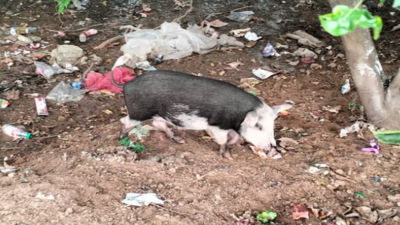
“While there are a few pig farms in and around Chennai, it’s mostly backyard breeding. People just buy the pigs but don’t look after them or feed them. These animals roam around on their own, feed on garbage and has become a nuisance for the residents of the area,” says animal welfare activist Dinesh Baba.
India has 9.06 million pigs as per the 20th Livestock Census published by the Ministry of Fisheries, Animal Husbandry and Dairying. These animals, farmed for their meat, are often reared and butchered in a cruel manner.
In urban areas, pigs seen roaming on public streets are often deemed ‘stray pigs’. These are pigs which have been temporarily abandoned by the owners who don’t want to provide food, water or shelter to these animals they use for commercial purposes.
About a month ago, a few residents of Ayyappanthangal slaughtered a pig in the open. Its baby ran around the neighbourhood in panic, till an animal lover somehow managed to rescue her, put her in a crate and then contacted animal Dinesh. Today, Peaches lives peacefully in a shelter run by the activist. But not all pigs are as lucky.
“There is absolutely no regulation of ownership of any animals in the city. You find even cows on the streets and on pavements. Since they yield milk, the owners take some care but pigs are generally left to fend for themselves,” says Shiranee Pereira of People for Animals.
Animal welfare activist Antony Rubin says that people are rearing pigs in their backyards as it involves little investment. “People just buy the pigs, which breed. It is especially seen in the outskirts of the city, where there is still open land where garbage is dumped,” he says.
Sale of pig meat in particular is a weekend business. The animals are usually rounded up and slaughtered on Saturday, and the meat sold on Sunday mornings at stalls in areas such as OMR, Pallavaram and 100 feet road.
It is very difficult to catch pigs. The pig catchers use long bamboo poles with an aluminium loop at the end, and strangle them, while the animal squeals in pain,” says Shiranee. This is in clear violation of the Prevention of Cruelty to Animals Act 1960, and Slaughter House Rules 2001.
Residents of these areas are also afraid of the pigs, as they fear being attacked and are also worried they will spread disease. “People dump garbage and household waste in the open, attracting pigs. We are worried as they can attack and we have children around,” says Shanmughapriya Naresh, a resident of Ambattur.
Dinesh says that activists have tried filing cases against the owners. “The local police station will relocate the animals or ask animal shelters to take them. The owners usually come and demand the animals back as its business for them, as a pig can weigh 100kg to 150kg and pig meat sells at Rs 300 a kg,” he says.
Chennai Corporation veterinary officer Kamal Hussain says the corporation does not have a team to catch pigs. “We only hire private catchers. They catch the pigs and take them out of the city. They either slaughter them or breed, it’s up to them,” he said.
If residents complain about pigs creating a nuisance in the neighbourhood, the corporation hires private catchers who capture the pigs and relocate them outside the city.
Hussain says public pig slaughter is illegal and whenever they get complaints they take action. “There’s no corporation slaughterhouse separately for pigs,” he says.
“The onus to ensure care of any animal - whether inside a larger establishment or in the case of abandoned pigs, is with the owners as per Section 3 of the Prevention of Cruelty to Animals Act, 1960,” says Sunayana Sibal, Specialist - Public Policy, Farm Animal Protection Campaign at Humane Society International/India.
As per Section 11(1)(h) of the Prevention of Cruelty to Animals Act, 1960 the pigs are to be provided sufficient food, drink & shelter; and as per Section 11(1)(i) of the Prevention of Cruelty to Animals Act, 1960 pigs cannot be abandoned in a manner that causes them pain due to starvation or thirst. Therefore, by temporarily abandoning pigs, owners violate all the above-mentioned statutory provisions.
“In addition, the local Municipal Corporation Acts (or its equivalent) have provisions pertaining to the abandoned animals as well, which would extend to pigs, she says.
Animal welfare activists and organisations have been campaigning to stop such cruelty towards farmed animals such as pigs and chickens. As the country celebrated 75 years of Independence last year, animal welfare activists demanded “freedom from lockdown” for pigs and chickens in cages. Activists from Mercy For Animals and People For Animals dressed in pig and chicken costumes and held placards reading, ‘Freedom for All’, calling for a ban on gestation crates used to confine pigs and battery cages used to confine laying hens.
“Pigs confined in gestation and farrowing crates suffer bone degeneration and show signs of extreme stress, including biting the metal bars of their crates,” said Nikunj Sharma, chief executive officer of Mercy for Animals India Foundation. “It is time for the central government to ban cruel crates across the country.”
Gestation crates are two-foot-wide and seven-foot-long metal enclosures in which pigs used for breeding are kept during their four-month-long pregnancies. Battery cages are systems of barren wire cages placed side by side used to confine hens in the egg industry. Both types of enclosures are extremely cruel and prevent the animals from displaying many natural behaviours essential for their physical and mental well-being
“People hold so many misconceptions about pigs. We think of them as animals who lack the ability to feel and experience, whereas a single interaction with a pig will shatter that misconception. Reality is pigs are highly intelligent to the extent that several researchers have found they can even play video games with significant accuracy levels,” says Sunayana. “Rearing a large number of animals in confined spaces or such irresponsible ownership has an obvious negative effect on animal welfare, but also on the environment and public health.”
That’s why, for these ethical reasons, people are opting for plant-based foods. “When we make a decision to opt for plant-based meats, we are not just changing what's on our plate, we are changing for better the lives of millions of animals,” she says.
(With inputs from Omjasvin MD)
End of Article
FOLLOW US ON SOCIAL MEDIA
Visual Stories









Photostories

Hot Picks
TOP TRENDING
Explore Every Corner
Across The Globe
Bihar Guard Bharti RegistrationLebron JamesTaylor SwiftMK StalinSolar Eclipse 2025SBI Prelims Result 2025Who is EL GrandeDerrick HenryWayne GretzkyCanada immigration rejectionDonald Trump InvitationShaquille O'nealUS Green Card HoldersDonald TrumpNew NEP SyllabusActor Kuruganti ApsaraPatrick MahomesIPL Highest Inning ScoreCanada VisaMarcus JordanTravis KelceStephan A SmithIPL Match TodayIPL StatsIPL TeamsIPL Live ScoreIPL ResultIPL Points TableIPL Schedule 2025
Hot on the Web
Solar Eclipse 2025Navratri 2025L2 Empuraan ReviewBlood Pressure ControlL2: Empuraan Twitter ReviewHair Mehendi Side EffecctsRhea ChakrabortyEgg PricesWorld Strongest CurrenciesAishwarya Rai$2 Bill HistoryZahan KapoorSara Ali KhanJaya BachchanRekhaVirat KohliGreen Tea BenefitsHigh Cholesterol SymptomsIndia VS Pakistan HospitalityVeera Dheera Sooran ReviewSnow Leopard BhutanBrain ExercisesOkra Water BenefitsIntelligent Freshwater FishesBanana BenefitsNational Parks AsiaLiver Cleanse HabitsDiplomat Box Office CollectionChhaava Box Office CollectionShakespeare Quotes
Trending Topics
JNVST 2025 ResultsBihar Board Class 10 ResultGhibli Style ImageSBI Clerk Prelims ResultTrump TariffsCSK vs RCB Head to HeadAakash ChopraPM ModiRiyan Parag Unwanted RecordDak PrescottLSG Squad IPL 2025SRH Squad IPL 2025Sunil GavaskarRoyal Enfield Classic 650Goa HSSC ResultIshan KishanAISSEE Admit CardAamir KhanKKR Fan Breach SecurityWhere to Watch IPLSundar PichaiSolar Eclipse Timing In USMickey NoniakWordle TodayKVS lottery resultR AshwinPublic Holidays AprilBank Holidays AprilIPL Orange CapIPL Purple Cap
Popular Categories
HeadlinesSports NewsBusiness NewsIndia NewsWorld NewsBollywood NewsHealth+ TipsIndian TV ShowsTechnologyTravelEtimesHealth & FitnessWWENFLICC Champions TrophyAstrologyWeather TodayIPLHow to watch IPL 2025How to watch IPL in CanadaHow to watch IPL in USAIPL TeamsStock Market HolidaysNSE HolidaysBSE HolidaysMCX HolidaysTechnology NewsInternational SportsPublic HolidaysBank Holidays
Latest News
Motor accident claims tribunal awards Rs 28 lakh compensation to family of deceased transport managerKareena Kapoor gets nostalgic as she revisits special moments with Aamir and Saif Ali KhanFiery and frustrated: Zodiacs that lose their cool quicklyDak Prescott trade rumors crushed as his no-trade clause and contract end the debateGold smuggling case: Actor Ranya Rao bail plea rejected for the 3rd timeANCIENT WISDOM, MODERN GUARDIANS‘I made history, but Sonia Gandhi refused to take my call’World Tuberculosis DayRanya Rao gold smuggling case: DRI arrests third suspectValorant Star Brenno “zap” Roberto parts ways with 2GAME Esports, with reasons unknown: ReportSaurabh Sharma's gold bars, cash asserts seized by ED: Total attachment hits Rs 100.36 croreDonald Trump imposes 25% import tariff on car imports; Elon Musk responds ‘this will affect the…’Jessica Alba goes on trip to Mexico City amid divorceGround Zero First Poster: Emraan Hashmi starrer promises an action entertainerWagle Ki Duniya: Ananya moves in with the Wagles creating a stir with her opulent lifestyle‘Will not apologise in this life,’ says SP MP on Rana Sanga remark, cites Nehru's bookVirat Kohli’s lookalike in Turkish drama sparks viral social media buzz | WatchWWE’s young John Cena fan from Brussels is not giving up on his hero
Copyright © 2025 Bennett, Coleman & Co. Ltd. All rights reserved. For reprint rights: Times Syndication Service