
- News
- City News
- chennai News
- DMK income sees 800% jump in a year
Trending
This story is from March 8, 2019
DMK income sees 800% jump in a year
The DMK’s income rose from Rs 3.78 crore in 2016-17 to Rs 35.74 crore in 2017-18, an increase of 845.71%. Among regional parties, the DMK’s income increased the most and it was attributed to the fee collected by way of renewal and new membership drive, which accounted for Rs 22.14 crore. The party also earned Rs 11.77 crore as interest from its various bank deposits.

Among regional parties, the DMK’s income increased the most and it was attributed to the fee collected by way of renewal and new membership drive, which accounted for Rs 22.14 crore.

The Samajwadi Party topped all the regional parties with a total income of Rs 47.19 crore, followed by the DMK. In comparison, the ruling AIADMK earned only Rs 12.72 crore, indicating a drop of 74% compared to the previous year, when its income was Rs 48.88 crore.
“It was during the financial year 2017-18 that we asked all DMK functionaries to renew their membership and admitted more members. Applications were sold for renewal of membership and members had to pay the subscription too. Many members also paid the subscription that was pending for several years at one go,” said a senior DMK leader.
The total income of all 37 regional parties for 2017-18, was Rs 237.27 crore. The total income of top three parties (SP, DMK and TRS) amounted to Rs 110.21 crore, 46.45% of the total combined income of all the 37 regional parties.
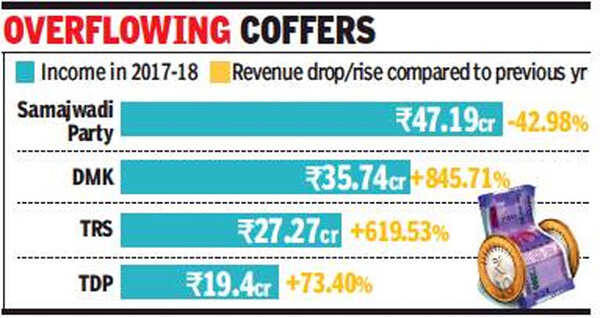
The total expenditure of all the regional parties stood at Rs 170.45 crore. Of this, the top three parties that spent more than all others were Samajwadi Party at Rs 34.53 crore, followed by the DMK at Rs 27.47 crore and TDP with Rs 16.73 crore. Expenditure incurred by the top three political parties is 46.19% of the total expenditure, reported by the regional parties.
Audit reports of 11 parties were not available on the website of the ECI, a delay of 127 days from the due date for submission, which is September 30 of every year.
“Any party which does not submit its income tax returns or donation statement to the ECI on or before the due date, their income should not be exempted from tax and defaulting parties should be derecognized,” said the ADR in its recommendations.
Accounts of regional parties which do not follow the ICAI guidelines for auditing of reports should be scrutinized by the income tax department, the recommendations said.
End of Article
FOLLOW US ON SOCIAL MEDIA





Hot Picks
TOP TRENDING
Trending Stories
In City
Entire Website
- 'Osama's 'dead son' is alive, leading al-Qaida in Afghanistan and has terrifying plans'
- Diljit Dosanjh’s Dil-Luminati India Tour: Check dates, venue, how to book concert tickets online
- Hamster Kombat Daily Cipher Codes and Combo Cards for September 13, 2024: Unlock up to 1 million coins
- Narayana Murthy faces backlash for parenting remarks on social media; users say, "after working 72 hours a week, there’s barely time left to have babies…”
- Shreyas Iyer comes out to bat wearing sunglasses, falls for a duck in Duleep Trophy
- iPhone 16 will be available for Rs 54,900 on Apple website; here's how you can grab the deal
- iPhone 16 to go on pre-order today: Pre-booking details, time, sale date and more
- Vande Metro launch date, schedule: PM Modi to flag off Bhuj-Ahmedabad Vande Metro train; check timings, stoppages of new Indian Railways train
- Why around 40,000 TCS employees have received tax demand notices for Rs 50,000 to over Rs 1 lakh
- Bill meant to usurp Waqf land, JPC told
- Ahead of PM Modi's Doda rally, 2 soldiers killed, as many injured in operation to smoke out terrorists
- Satellite-based toll system to have factory-fitted unit, phased launch
- Actor dies in his sleep. Why sudden heart attacks are killing Indians
- Troops disengaged in 4 areas, including Galwan valley: China
- 'Made to work for 15 hours a day, were fired at if we slacked off'
- Door-to-door campaigns back in J&K, first since 1987 election
- Why Rahul should talk more about jobs and less about ideology
- Jhumka Gira Re ...: American woman's Instagram post on India goes viral
- HC CJ appointments delayed due to ‘sensitive material’ with govt, AG tells SC
- Vande Metro first look: Top 10 features of new train for common man

Popular Categories
Hot on the Web
Top Trends
Shannon Sharpes Net WorthVande MetroAadhaar Card UpdateTech LayoffsArvind Kejriwal BailShannon SharpeUPSC Mains Admit CardKristina JoksimovicTCS Employee Tax NoticesWay Chatgpt can be your Study PartnerAir Taxi IndiaAyushman Bharat SchemeKolkata Doctor Rape CaseDonald TrumpShreyas IyerDiljit DosanjhLive Cricket Score
Trending Topics
Alia BhattMalaika Arora Father DeathArbaaz KhanNatasa StankovicMr Bachchan OTT ReleaseNational Parks In IndiaSelena GomezGOAT CollectionVikas Sethi DeathMalayalam ProducersIndia's Best Dancer 4Simi GarewalDilli BabuIndian National ParksLaung BenefitsVikas SethiApple iPhone 16SpaceXAadhar Card Update By Sept 14Wordle Answer
Living and entertainment
Latest News
Regina Cassandra calls herself a 'serial dater,' had many relationships :'But I’m taking a break now'Kaun Banega Crorepati 16: Can you guess the answer for this Rs 3,20,000 question on Navy, which contestant Naman Jain incorrectly answered?Exclusive - Has Palak Sindhwani aka Sonu from Taarak Mehta Ka Ooltah Chashmah breached her contract; Neela Film Productions to issue a legal notice to the actress?Mexico's president asks Sinaloa cartel to act 'responsibly' as violence escalates in the northKitchen Tips: How to elevate home cooking to Michelin levelFord drives into India for 3rd timeGrowth potential 7.5% or more: RBI governorHindus take to Bangladesh streets to stop attacks and demand justiceE-commerce speeds up to catch up with Quick commerce'Will take digital public infrastructure stack to 50 nations'Tragic road accident on Mogili ghat road claims seven lives in Chittoor districtSebi gives clean chit to NSE, ex-executives in co-location caseRusty or Ready? Falcons' Cousins Falls Flat in $180M NFL DebutRaveena Tandon apologizes to fans for not photo snub in London: "It was not my intention to offend"Preschools turn nursing homes, retirement age raised: China's demographic crisis explodesBest Phones Under 35000 To Smoothly Carry Out Multiple Tasks On A BudgetBest 50 Inch TV Models: Find Your Perfect Match Across Budgets from Leading BrandsHow to manage eczema in babies
Copyright © 2024 Bennett, Coleman & Co. Ltd. All rights reserved. For reprint rights: Times Syndication Service