
- News
- City News
- chandigarh News
- High-risk pregnant women to get random calls in Punjab
Trending
This story is from March 27, 2024
High-risk pregnant women to get random calls in Punjab
Punjab strives to reduce Maternal Mortality Rate through interventions like random calls to high-risk pregnant women. The state reviews maternal deaths, ensures proper care, and involves various healthcare professionals and institutions for effective coordination and improved healthcare quality.
Representative image
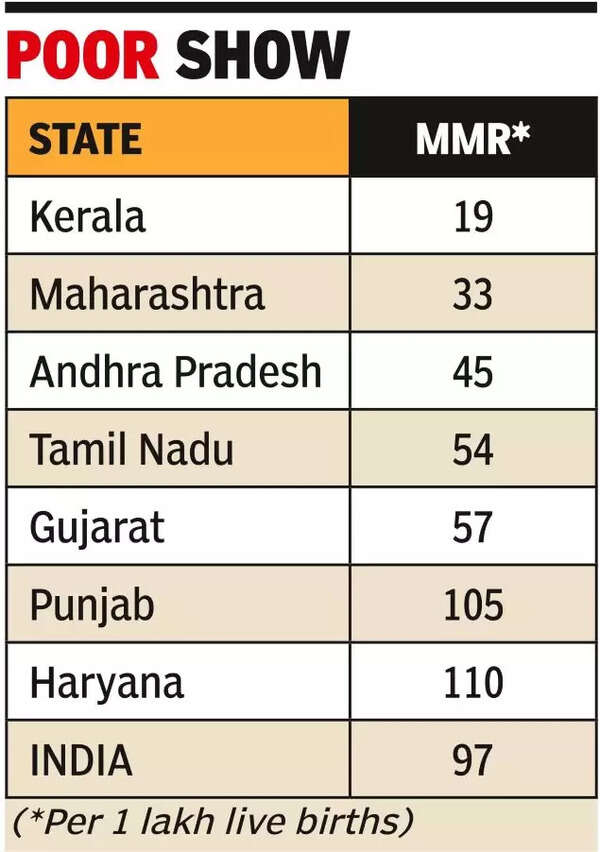
The maternal mortality ratio, a crucial indicator of healthcare quality within a state, currently stands at 105 per lakh live births in Punjab, compared to the national average of 97.

States like Kerala (19), Maharashtra (33), Andhra Pradesh (45), Tamil Nadu (54) and Gujarat (57) have already achieved this target.
Between Feb 19 and Feb 25, Punjab witnessed nine maternal deaths and all these deaths were reviewed by the principal health secretary Ajoy Sharma, following which directions were issued for taking corrective measures.
All civil surgeons, district family planning officers (DFPOs) and senior medical officers (SMOs) have been instructed to maintain an up-to-date list of high-risk pregnant women containing details of accredited social health activists (ASHA), auxiliary nurse midwives (ANM), and community officers (CHO) concerned, along with the expected date of delivery.
District officials are tasked with making random calls to these identified high-risk pregnant women to inquire about their health status and birth preparedness.
The primary objective of these random calls is to evaluate the quality of care provided to high-risk pregnant women and identify areas for improvement.
‘Compile Detailed Presentations’
Districts are required to compile detailed presentations outlining the outcomes of the random calls, highlighting any identified gaps, and detailing the corrective actions implemented to rectify them.
To facilitate communication regarding the management of similar complications, officials have been instructed to share details of maternal deaths in public domains, including both public and private hospitals.
Officials have to maintain confidentiality, ensuring that no individual's name, identity, hospital name, or district name is disclosed.
The services of the Postgraduate Institute of Medical Education and Research (PGIMER), Chandigarh can be utilised through teleconsultation for critical health issues such as Immune Thrombocytopenia during pregnancy, where specialised consultation is required.
Instructions have also been issued to director health services to formulate and circulate protocols related to the labour room, perineum care and emergency referral to the districts. All high-risk pregnancies will be followed up until 45 days post-delivery by the ASHAs.
Medical officers and community health officers will be designated to ensure regular tracking and follow-up of high-risk pregnant women.
Senior medical officers (SMOs) will oversee the community health officers for tracking high-risk pregnancies.
To Rope In AACs
To address the challenge of manpower shortage, it has been decided to involve Aam Aadmi Clinics (AACs) in providing consultations to pregnant women.
During the review meeting chaired by the principal health secretary, it was observed that the antenatal care (ANC) registration of a deceased pregnant woman from Ludhiana was missed due to the high population load on the ANM, who was responsible for a population of 90,000 in the area.
To tackle this issue, a mapping of AACs will be conducted in areas where the number of ASHAs and ANMs is inadequate. Directions have been given to sensitise the staff of AACs to provide healthcare services to pregnant women.
They will undergo training to identify high-risk pregnancies and provide a minimum of five-minute consultations to pregnant women visiting AACs. The health department will develop a standardised IT module for pregnant women in AACs.
Emphasis has been placed on ensuring effective coordination among SMOs, AAC staff, CHOs, ANMs, and ASHAs to provide quality care to pregnant women and reduce MMR. Instructions have been given to prominently display the names and contact details of SMOs, CHOs, ANMs, and ASHAs in every hospital and AAC.

About the Author
Vinod KumarEnd of Article
FOLLOW US ON SOCIAL MEDIA










Hot Picks
TOP TRENDING
Trending Stories
In City
Entire Website
- Travis Kelce Net Worth 2024, Current Salary and More
- Jordan Love Luxurious Lifestyle: Expensive Properties, Net Worth, Car Collections and more
- Watching, downloading child pornography are offences under POCSO Act: SC
- Tirupati laddu controversy: Former TTD chairman moves SC, seeks probe into lab report
- EXCLUSIVE | Rohit Sharma to Akash Deep after no-ball drama: 'Aage badh, hota rehta hai'
- Coldplay India tour 2025: Band announces new show in Mumbai; check dates, how to book tickets and more
- Kerala lottery results: Win Win W-788 winners for 23 September 2024; first prize Rs. 75 lakhs, second prize Rs 5 lakhs and third prize Rs. 1 lakh
- Withdrawal symptoms: IMD issues orange alert for Tue
- Without these two players, India can't form a Test playing XI: Kamran Akmal
- Tamil Nadu to develop city's own 'Central Park' on 118 of 160 acres of MRC land
- TN governor says secularism European concept, not needed in India
- Bangladesh protests Amit Shah's 'hang infiltrators upside down' remark
- Why do Indians glorify overwork even if it kills them?
- Pakistan names US-educated general as new ISI chief
- Will push for restoration of J&K’s statehood: Rahul Gandhi
- 65 of 238 candidates in phase 2 of J&K polls facing criminal cases
- As Sri Lankans swing left, will India get another hostile neighbour?
- Uncademy CEO: 'Didn’t clear JEE. But got the Coldplay tickets…'
- Engineer Rashid accuses Omar, Lone of ganging up against him
- Badlapur accused shot dead after opening fire in police custody

Popular Categories
Hot on the Web
Top Trends
Tirupati Laddu ControversyPM Modi US Visit LiveAkash DeepEY Employee DeathRishabh PantIsrael Hezbollah WarVirat KohliAnura Kumara DissanayakeJetblue Flight Emergency LandingRyan RouthAwadhesh PrasadUGC NET ResultBengaluru Mahalakshmi MurderRohit SharmaBadlapur School Sexual Assault CaseShoaib AkhtarLive Cricket Score
Trending Topics
Laapataa LadiesZodiac SignsBigg Boss 18The Great Indian Kapil ShowChia SeedS ShankarOptical IllusionSharp Eye TestChiranjeevis FarmhouseSana KhanDevaraStree 2 CollectionAnupam MittalHealthy RaitasUrvashi RautelaColdplay India tour 2025Best Laptops For CodingPM Narendra ModiAnupam MittalWordle Answer
Living and entertainment
Latest News
Olivia Munn and John Mulaney welcome second daughter via surrogateNaseeruddin Shah, Ratna Pathak Shah bring old world charm to DelhiBigg Boss Tamil 8: VJ Jacquline to participate in the upcoming season?Kim Jung-nan chooses Song Joong-ki as most appealing actor, praising his care and leadershipYour Birth Chart Explained: Unlocking the Secrets of Your Cosmic BlueprintGoogle CEO Sundar Pichai after meeting PM Narendra Modi in US: “He pushed us to continue..”Alia Bhatt reveals Ranbir Kapoor sings Malayalam lullaby 'Unni Vavavo' to daughter Raha Kapoor: 'She cues, ‘Mumma vavo, papa vavo’'How Sachin Tendulkar became 'The Little Master'Amid Odisha custody abuse row, Puja held at police station; CCTVs installedBest Time To Upgrade To 4G & 5G Tablets: Lightning-Fast Performance At Unbeatable PricesEssential tips for building and maintaining a happy marriageBo Nix and Wife Izzy Celebrate Broncos' First Win of the SeasonTirupati Laddoo Controversy: What is Beef Tallow and why was it addedWhat is the ABCDE algorithm for the prevention of heart disease?'Show proof or face ... ': Himachal Congress warns Kangana Ranaut over her 'foolish' statement on state funds being diverted to Sonia GandhiTrump attempted assassination suspect Ryan Routh to appear in courtSwara Bhasker reveals pre-wedding fear about marrying Fahad Ahmad; Says, 'I will not be called for Bollywood Diwali parties'Nitanshi Goel on 'Laapataa Ladies' Oscar entry: I am full of goosebumps- Exclusive!
Copyright © 2024 Bennett, Coleman & Co. Ltd. All rights reserved. For reprint rights: Times Syndication Service