
- News
- City News
- bengaluru News
- Karnataka: RTCs may need fund push to power free rides for women and stay afloat
Trending
This story is from May 31, 2023
Karnataka: RTCs may need fund push to power free rides for women and stay afloat
The new transport minister, Ramalinga Reddy, is set to announce the fate of the Shakti scheme on June 1. A pre-cabinet meeting scheduled at 12pm on Wednesday will discuss the financial and operational modalities of the scheme, which promises free public bus transport for women, and seal the deal.
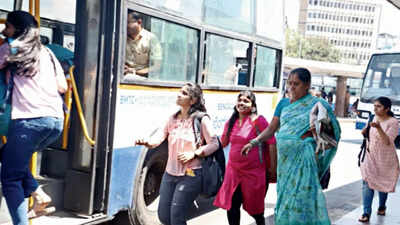
Reddy convened a two-hour meeting on Tuesday, with the heads of all four transport corporations under the Karnataka government to understand the current status of operations, costs and revenue of the public bus transport sector.

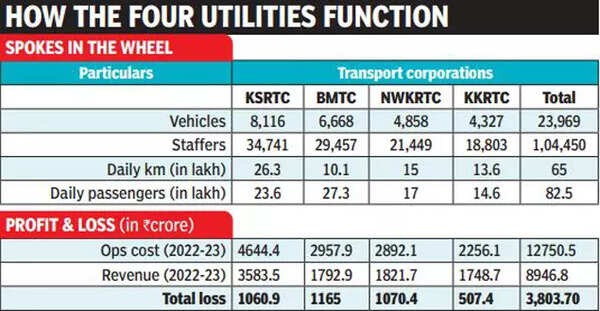
Representatives from Bangalore Metropolitan Transport Corporation (BMTC), Karnataka State Road Transport Corporation (KSRTC), North Western Karnataka Road Transport Corporation (NWKRTC) and Kalyana Karnataka Road Transport Corporation (KKRTC) were present at the meeting.
Sources from the departments concerned told TOI that the free travel option cannot be sustainable for the corporations unless the state government agrees to a consistent provision of funding to meet the cost burden.
All four bodies under loss
BMTC, KSRTC, NWKRTC and KKRTC cumulatively earn about Rs 23 crore daily. At the meeting, the minister was apprised that 40% of the earned amount is spent on procuring diesel every day. “About Rs 13-14 crore worth of diesel is bought for all four corporations,” he was told. Another 40% is set aside for staff salaries and the rest goes towards other operative expenses. During the 2022-2023 financial year, the corporations earned about Rs 8,945 crore of revenue and spent Rs 12,750 crore, incurring a loss of Rs 3,805 crore.
Minimum of Rs 12 crore daily, more buses needed
Together, the state public bus corporations ferry nearly 83 lakh passengers every day, 41 lakh of them women. Free transport for women would mean the utilities will lose 50% of the daily revenue or Rs 11.5 crore, making daily operations impossible. “With half of our revenue lost to the scheme, we will not be able to purchase fuel for a day’s operations. A lifeline of a minimum Rs 11.5 crore is needed daily to keep the corporations working at a bare minimum,” a source said.
If the International Women’s Day experiment — when women were allowed free bus rides by BMTC — was any lesson, the number of women travellers will triple if and when bus rides are made free.
On March 8, 66% of BMTC passengers were women against the daily estimate of 25%. On regular days, BMTC ferries about 29 lakh citizens (men and women) but on March 8, it ferried 33 lakh people of which 22 lakh were women. With only 6,688 buses in its fleet, the Bengaluru bus agency will drown in a sea of riders if more buses aren’t added to cater to the increased demand, experts said.
End of Article
FOLLOW US ON SOCIAL MEDIA





Photostories

Hot Picks
TOP TRENDING
Popular Categories
Hot on the Web
Top Trends
Stock Market TodayBasit AliBrittany MahomesRavichandran AshwinBabar AzamKanpur Test Match RecordsUGC NET Result 2024Tirupati LadduIndia T20 WC SchedulePPF CalculatorBryonna Burrows Net WorthWomen T20 World Cup Points TableWomen T20 World Cup ScheduleIND vs PAK T20 WC MatchDiddyTop Management Colleges of IndiaLive Cricket Score
Trending Topics
GovindaNavratri Colours 2024Solar Eclipse 2024 TimesNavratri WishesGandhi Jayanti WishesDevara CollectionGOAT OTT ReleaseGandhi Jayanti 2024Rajinikanth Health UpdateNavratri HistoryDevaraGovinda NewsDevara Movie ReviewHealthy RaitasSwatantrya Veer SavarkarColdplay India tour 2025Upcoming Smartphones In OctoberAmazon SaleSony Bravia 55 inch 4k Ultra HD TVWordle Answer
Living and entertainment
Latest News
Zodiac Signs as Romantic Movie CouplesJapanese artist’s tribute to Indian classical dance formAnanya Panday unveils her Amol Palekar-inspired look in quirky BTS PICS from 'CTRL’Sanjay Dutt celebrates 'Gandhigiri', shares a scene from 'Lage Raho Munna Bhai'Women's T20 World Cup 2024: Teams, format, venues, defending champions and more FAQs answeredGovinda's bullet injury: Mumbai police not convinced with actor's version but rule out foul playHaircuts and colours to try out this PujoTriptii Dimri denies skipping the Jaipur event after allegations of charging an appearance feeFormer WWE Champion Jeff Hardy talks about “addiction struggles”Qualifier Yash upsets second seed Manish at Fenesta Open'Scam marathon' under JMM-Congress-RJD rule 'biggest obstacle' to Jharkhand's development: PM ModiPopulation of Hindus & tribals declining in Jharkhand, says PM ModiWHO chief praises PM Modi on 10th anivarsary of Swachh Bharat missionNasa switches off instrument on Voyager 2 spacecraft to save powerAre 3 senior Karnataka mantris jockeying for chief minister's chair?Best Leather Wallets for Men in 2024: Timeless EleganceArya's film faces controversy for not paying junior artists on timeGomathi Priya and Vetri Vasanth's 'Siragadika Asai' completes 500 episodes
Copyright © 2024 Bennett, Coleman & Co. Ltd. All rights reserved. For reprint rights: Times Syndication Service