It’s a feeling that cuts across generations. The sheer exhaustion of it all. Will working hard result in better prospects? Will ambition lead to success? What exactly will the workplace even look and feel like in this age of AI, where disruption seems the only constant? We all feel it, whatever our age. But for
Gen Z, it almost feels like the finish line is where they are starting from. We will get to this. For now, let’s dissect a few workplace reports that tell us why Gen Z feels exhausted even before their careers have begun.
Recent workplace and HR reports, including findings highlighted by Ipsos (a global market research and consulting firm) and Monster (an employment and job search platform), warn that burnout and instability may soon overtake AI itself as the defining workplace crisis of the decade. Here’s why.
Younger millennials and Gen Z workers entered adulthood during an era of permanent instability marked by pandemic disruption, layoffs, AI anxiety, gig work, rising costs, digital surveillance, hustle culture, and relentless identity-branding pressure. The exhaustion emerging from this environment is cumulative rather than individual, shaped less by personal weakness and more by years of adapting continuously to uncertainty.

Gen Z workers entered adulthood during an era of permanent instability marked by pandemic disruption, layoffs, AI anxiety, gig work, rising costs, digital surveillance, hustle culture, and relentless identity-branding pressure. The exhaustion emerging from this environment is cumulative rather than individual, shaped less by personal weakness and more by years of adapting continuously to uncertainty. (AI generated)
Earlier generations often associated work with upward mobility and long-term security, but many younger workers increasingly experience employment as a means of maintenance and survival, where the primary goal is not necessarily progress but remaining employable inside rapidly shifting economic and technological systems.
These findings point towards a deeper generational reality: This is no ordinary job stress. Professional conversations are no longer about long hours or difficult bosses. It is about a generation entering professional life in conditions of relentless uncertainty, where instability is not an interruption to adulthood but the defining atmosphere of it. Young professionals today are not burned out from extraordinary success or punishing ambition. That was the previous generation. Late Millennials and early Gen Z are exhausted from the idea of permanence without any security. Visibility without any stability. And effort without the promise that things will improve. The fatigue feels difficult to explain because it is cumulative.
The generation that entered adulthood during crises
Pandemic, mass layoffs, AI disruption. Everything around us, which gave us a sense of security and permanence, has collapsed. What this has led to is a slow psychological erosion among the young generation entering the work force. Doesn’t matter which field. This sense of doom is everywhere. And it’s a result of years of adapting to crisis after crisis (2020 - 2026) before adulthood ever got the chance to be properly settled.
Every generation carries the imprint of the historical moment in which it comes of age. For Gen Z, adulthood did not begin during economic optimism or institutional confidence. It began during disruption. First came the aftershocks of global financial instability that altered family expectations and employment markets. Then came the pandemic, which interrupted education, isolated young people during formative years, and transformed work into something simultaneously more invasive and more precarious.
For younger Millennials and Gen Z workers, professional life began under profoundly different conditions from those experienced by earlier generations. At times, we may not even think of the psychological toll of not experiencing college life. But it has left a deep hole in particularly one generation. Among all other disruptions due to the pandemic, Gen Z is the only generation that attended college online. Previous generations know that college is the buffer between leaving academic life behind, and stepping into the real world. That buffer is not always what’s taught in colleges. It’s friendships, it’s aimlessly wandering about in campuses. It’s making new friends. It’s slowly gaining confidence in oneself as the old, more protected lives are left behind to accept new people, new challenges… all leading up to a promise to a better world. Gen Z had none of these. And they stepped on to their professional lives.
Continuously reinventing themselves while absorbing economic shocks, technological disruption, all under extreme emotional pressure is not normal. But for Gen Z, it’s another Tuesday. This exhaustion is often mistaken for fragility or impatience. But in reality, it may be one of the most rational emotional responses to the era they inherited. The era of trauma.
The era of trauma
And just as the world reopened, layoffs across technology, media, startups, and corporate sectors reinforced the message that no industry was truly secure. Then artificial intelligence arrived not merely as a tool but as a psychological event, introducing anxiety about replacement, redundancy, and shrinking relevance. To think the world isn’t fair would be an understatement.
Continuously reinventing themselves while absorbing economic shocks, technological disruption, all under extreme emotional pressure is not normal. But for Gen Z, it’s another Tuesday. This exhaustion is often mistaken for fragility or impatience. But in reality, it may be one of the most rational emotional responses to the era they inherited. The era of trauma.
The future doesn’t look good at all. The cost of ordinary adulthood is continuously rising. Housing has become harder to afford in major cities. Stable employment is increasingly giving way to contractual work, freelancing, temporary consulting, or gig-based income streams. Many young professionals find themselves needing multiple forms of work simply to maintain the lifestyle that previous generations expected a single stable job to support.
This has altered the emotional meaning of employment itself. Earlier generations often associated work with upward mobility and gradual accumulation. Younger workers increasingly associate work with maintenance and survival. Hence, the anxiety. Hence the perpetual survival mode. The goal is no longer upward mobility. It’s simply to remain employable.
Gen Z’s
psychological relationship with ambition is very different from generations that came before. In fact, in the evolution of the corporate world or white collar jobs, never was the word ambition so perplexing. Even frightening. This is because this generation has lived several decades in the past six years. And they are burnt out even before entering the workforce.
Burnout without arrival
Traditionally, burnout was associated with achievement or overachievement – the exhausted executive, the overworked lawyer, the entrepreneur running on four hours of sleep after years of aggressive professional ascent. But Gen Z increasingly describes a different kind of fatigue altogether. It is not the exhaustion of reaching the top. It is the exhaustion of never feeling able to stand still.
In previous decades, expertise often produced security. Cut to 2026, what’s the point of remaining agile or upskilling for careers that may not yet even exist? The result is a generation trapped in anticipatory anxiety.
Death of psychological distance
Another defining feature of modern work is the collapse of boundaries between professional and private life. Earlier generations often experienced work as physically separate from home. Today’s young professionals carry workspaces inside their pockets. Emails arrive at midnight. Messaging platforms create expectations of constant availability. Productivity software tracks responsiveness, visibility, and engagement. Remote work, while offering flexibility, has also blurred psychological boundaries in ways that remain poorly understood.
Gen Z is permanently “on” – unable to fully disengage from its professional identity. Even leisure has become partially instrumentalized, transformed into networking opportunities, side hustles or worse… self-improvement projects. This constant low-level vigilance has produced a new brand of exhaustion that is difficult to measure. Because it rarely appears dramatic from the outside. Yet psychologically, the inability to mentally leave work creates a form of cognitive dissonance that has long-term effects on the mind.
The future of work is emotional
The problem is even while Gen Z has lived several decades in the past six years, the current workplace conversation still treats burnout as a side effect of economic systems or technological change. It’s not. Burnout is the defining emotional condition of an era shaped by permanent instability. What Gen Z is expressing is not dissatisfaction with jobs. It is exhaustion with a social environment that demands endless adaptation while offering diminishing certainty in return.
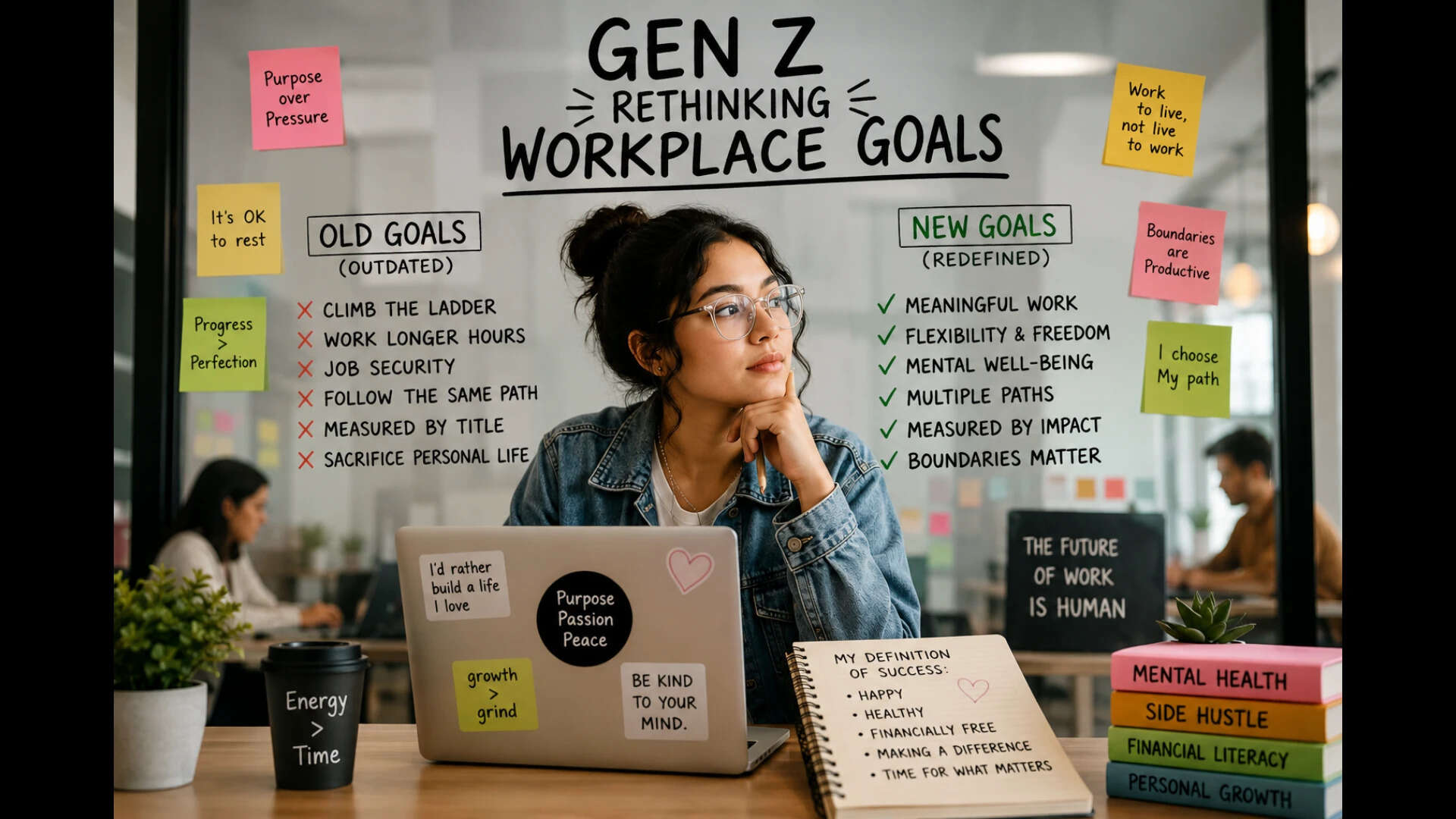
There is hope. If there is one thing this generation has also developed alongside exhaustion, it is adaptability on a scale rarely seen before. They have entered adulthood during instability, but learned to question unhealthy workplace cultures far earlier than previous generations did. Gen Z is more willing to speak openly about burnout, mental health, work-life boundaries, toxic productivity and emotional fatigue instead of silently normalizing them. This shift is tectonic. (AI generated)
Pandemic disruption, layoffs, inflation, AI anxiety, precarious employment, digital surveillance, and identity branding pressures did not arrive one after another in neat sequence. They accumulated simultaneously, layering stress upon stress until uncertainty itself became ordinary. That may be the deepest reason so many young professionals feel tired before their careers have even properly begun.
Why Gen Z carries the hope we all need
It remains to be seen if the corporate world has taken this factor into consideration for a better understanding of the generations joining the work force at the moment. But there is hope. If there is one thing this generation has also developed alongside exhaustion, it is adaptability on a scale rarely seen before. They have entered adulthood during instability, but learned to question unhealthy workplace cultures far earlier than previous generations did. Gen Z is more willing to speak openly about burnout, mental health, work-life boundaries, toxic productivity and emotional fatigue instead of silently normalising them.
This shift is tectonic. This generation may ultimately force companies to build workplaces that are more humane, flexible and emotionally aware than the systems they inherited. The future of work may still be uncertain, but Gen Z’s refusal to pretend everything is fine could become the very thing that changes work culture for the better.