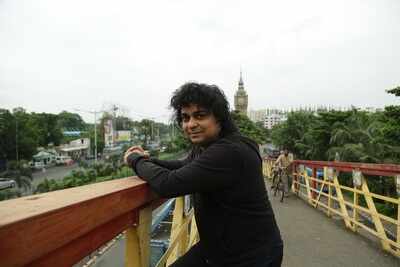
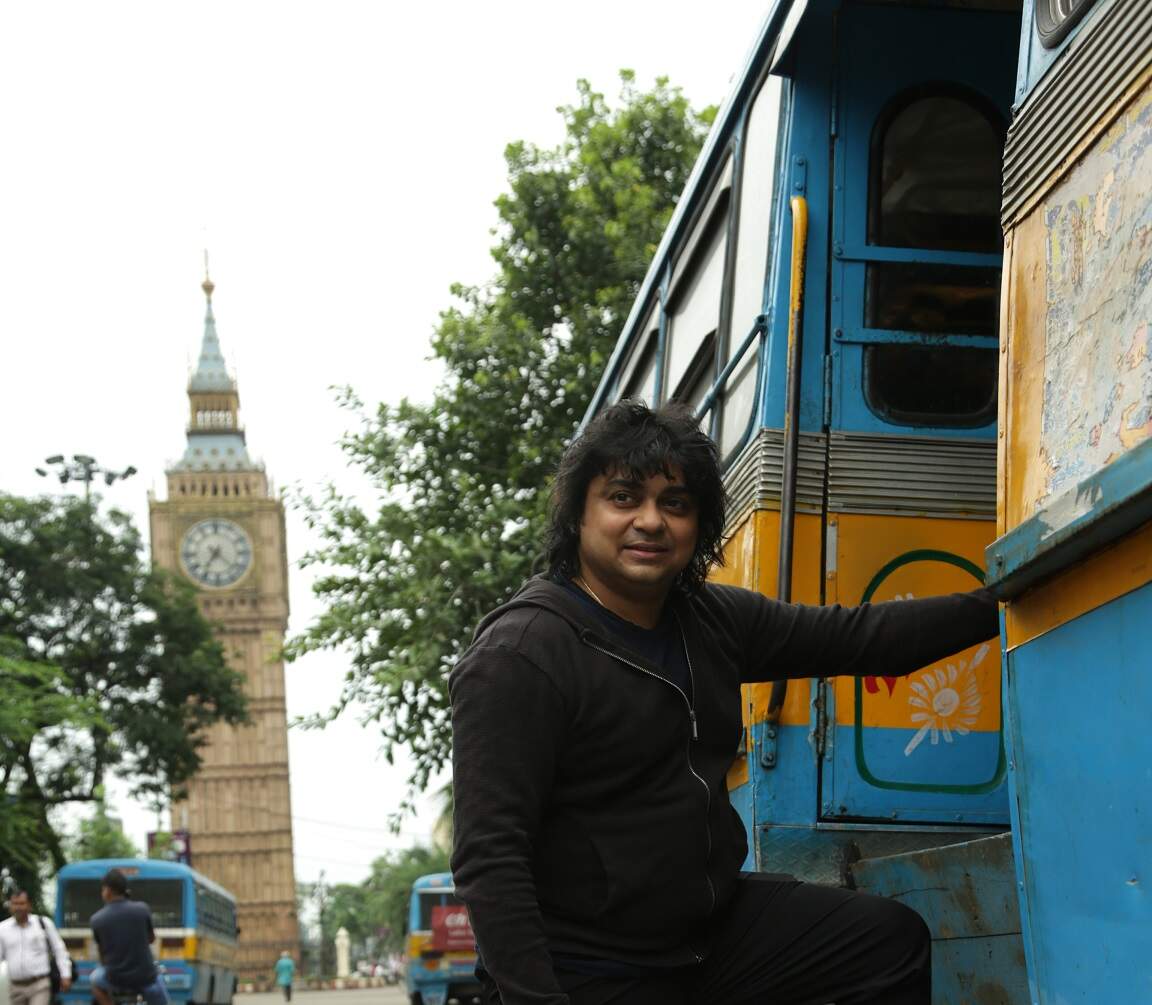
More than a decade back, in an interview to Calcutta Times, he had described himself as an “experiment” of his father, Pt Kartick Kumar. By then, albums of his like If and Sitar Gaze had released. Soon, from being the fifth generation sitar player, Niladri consciously burgeoned into a space reserved solely for lounge music. Bollywood embraced him and his red-hot zitar with open arms. He even worked in theatre. Awards for his work in classical and film world also came by.
Yet, on a moist evening in Kolkata after a performance at the Dumdum Margsangeet Utsav in the city, Niladri insists that there is still every reason for him to wear his success lightly. There is no put-on humility. No attempt to create an impression of being oh-so-modestly cool. Sipping a cup of jasmine tea at a café of a five-star property in the city, he confides that all his achievements are fruits of the experiment conceived by his father — a talented musician who had to once sell oranges and handkerchiefs on the streets of Sealdah to make ends meet. Tune in and read on…
We hear about the nepotism debate in Bollywood. What is your take on the same debate in the world of Indian classical music?If we see the history of our music, it was very much a part of the bloodline in the way it was propagated.
If you don’t have a direct descendant, the next descendant would be the daughter’s husband who would be given few thousands of bandishes as dowry to ensure the legacy would continue. So, the concept of nepotism has always been there. That’s why a doctor’s son has become a doctor and a king’s son too has become one. It is only some cases where mavericks have come up from nowhere and done wonders.
One can understand the lineage bit. But even when these mavericks reach a position of power, they too name their children when asked about promising disciples. Why do they get biased towards their bloodline instead of choosing to highlight talent more democratically?Yes, that happens. I don’t see this as something that should be debated because somewhere there were too many instances in films and many in music where a sure shot case of success never sprung to its potential. Why won’t nepotism trigger them is the question! One reply could be that being under a huge banyan tree doesn’t support the growth of another banyan tree. However, I don’t read much into this. I also can understand from the outsider’s point of view when they say that a deserving person didn’t get the right window to open his or her own door. Nepotism doesn’t only exist in music or cinema. It’s there in every sphere. That’s how human society works. Nepotism is a trait in the human being and you need to have the honesty to go beyond that.
Does excellence breed politics?The Internet throws up two meanings of politics. The first is: activities associated with the governance of a country or area, especially the debate between parties having power. The second is: activities aimed at improving someone’s status or increasing power within an organisation. Doesn’t the second meaning apply to all trade and all kinds of people? It does. Many would ask why not? But it’s sinful to use politics to deprive and not acknowledge excellence.
In an age of obsession with rhythm, you have a seductive control over melody. What’s the secret behind this?I don’t know the impact my music has. I have really never analysed it. I am just a small expression of the book of life my dad wanted to write. I feel each of us have our own unique journey to undertake. This seductive control over the melody perhaps comes from the fact that I am still searching. When I look back, I vividly remember my failures more than I remember the successes. Somewhere the aspect of pain and longing remains as a residue. The sentiment perhaps conditions the way I play. Besides, I feel blessed to have my father as my guru. I have grown up on stories of how much he struggled in poverty and still continued with his passion for music. As a teenager, my father had to sell stuff on the streets of Sealdah to support the large family even while he was learning music.
That’s a lot of hardship…Yes. Although we had sitar in our family for five generations, dad was in a very bad shape when the family shifted from Bangladesh to Kolkata. Dad used to sell oranges and handkerchiefs on the streets of Sealdah. He has even sold rice. When some buyer spotted the mizrab on his finger while he was selling rice, dad said he is a musician and practises sitar at night. My grandfather, Mangal Chandra Das, didn’t have the money to even buy a sitar. So, he bought the wood etc and dad did the chopping and gluing. But getting the fittings done is tricky. So, they went to Hiren Roy, paid some `12 or `15 to just get the fittings done. My father played with this sitar and went on to win the All India Radio presidents gold medal in 1958. So impressed was Pannalal Ghosh with his playing that he had told my father that Ma Saraswati was playing through his hands on the day of the competition.
You too have had your own share of struggles…Yes. I remember being called to record for movies. Back then, I was too young and would be pushed to the rear while seniors would place the microphone in front of their instruments. I would sit in the rear end and barely be heard. So, the impression would be that while I could play, I was barely good or loud enough to be heard. Those were struggles I have seen and finally, I came to a place where in that same recording space, I was asked to record from the singer’s booth. I remember the times when I would be called by ‘messengers’ to play for films. It was difficult to balance a sitar under an umbrella and travel long distance in the Mumbai monsoons. Yet, I would go. Imagine my shock when I would reach there only to find that my role was to play a dummy musician for a B-grade movie for which I would get Rs 500. I did that too.
Do such experiences ever flash on your mind when you perform? Some musicians insist they do have such moments. Some have even claimed that they think of passionate moments while playing the meend…No, never. Once the lights come on and I am on stage, nothing else matters apart from the music. I am only trying to be in sur, following the laya and executing the melody.
The honesty in not adding extra colour often sets you apart from many musicians who are consciously trying to cultivate the image of being a demi-God or making everything sound so poetic. Do you ever feel that this casual approach forces you to break away from the tradition and make you prone to criticism of being too arrogant?I sincerely believe I have not done anything for which I deserve to cultivate an image. There are such great legends who have done so much. I am just a fly on the wall in comparison to them. When you see what true greatness is all about, you know that you should carry your achievements very lightly. I learn so much when I am with Ustad Zakir Hussain. When you are not aware of true greatness, you start to think you know a lot. That’s not the case with me. I have done my reality check. I remember when I was in college, I used to wear a T-shirt of my father with the words Ravi’s band written on it since he was part of the Festival of India tour of Pt Ravi Shankar that was produced by George Harrison in 1974. Back then, the band used to travel in a chartered plane. Forget my own band, have any others in India done that? Why should I not be casual when I have never done anything remotely close to this? I laugh at people when they speak so much as: ‘I did this and I did that’. In the larger scheme of things, they need to realise that all of what they are talking about is so tiny.
When you are casual and talk without inhibitions while not completely explaining your POV, the entire exercise gets lost in translation. Even those who avoid gossip say you are speaking out of turn. Do you realise this pitfall?Yes, I know this happens. When you change a few norms, people can’t adjust to it. So criticism will happen. You, as an individual, will criticise to the hilt if you don’t like the change. You will criticise from the heart if you are asked to follow the change that you don’t like.
You have often said that a festival should not be bigger than the artiste. Why?A festival, which has been going on for five to six decades, is important. In our country, there are just two or three such festivals happening. They are not just important for young musicians or the generation next that are coming up. But it is almost like going into the arena where your great grandparents or great musicians had performed. That space becomes a little holy. It is almost like going to a temple. When you are told that this is an 800-year-old temple, your head will spontaneously bow down. The organisers know this. He should not have the arrogance to treat the musicians in a way that makes them feel that he is giving them an opportunity that they deserve or don’t deserve. That should not be the criterion to run such festivals. They should have the same humility and love for the art, music and musicians in the same way that musicians have for that place. It has to be mutual. Automatically, money and every other factor become not so important. When I see that attitude not being there among organisers, I prefer being the differentiating factor where it is known that Niladri hasn’t played here but we still know him.
Few musicians cut down on remuneration to play at all the concerts that come their way. Does that lower the bar or increase competition? An artist can never have a rate chart. There can be a minimum honorarium that an artiste can ask for. Even that changes depending on the venue, the festival and so many other factors. I have heard stories of musicians who have said that they will not open their instrument cases unless such and such amount have not been given. Unfortunately, they have never been able to open their cases after making such claims. Actually, I see this entire attempt to be redundant. Artistes are like unique flowers. Don’t club them into one bouquet and then start comparing.
Nowadays, electric sitar is very common. Would you say with zitar, you were the first musician to start this trend?Being the first is not as important for me as being the best. And to be that you need the love and blessings of everyone around you. I always strive for that. Actually I am bit of a sucker for these metaphysical aspects like blessings. Besides, who can be the first for anything anyway? There is always a reason and precedence and a need for things to happen.
"Get the latest updates on Times of India, including reviews of the movie
Coolie and
War 2."