

Swarm attack stopper: India's AI-powered anti-drone system with radar, jammers & hard-kill guns

Photo credit: Zen technologies
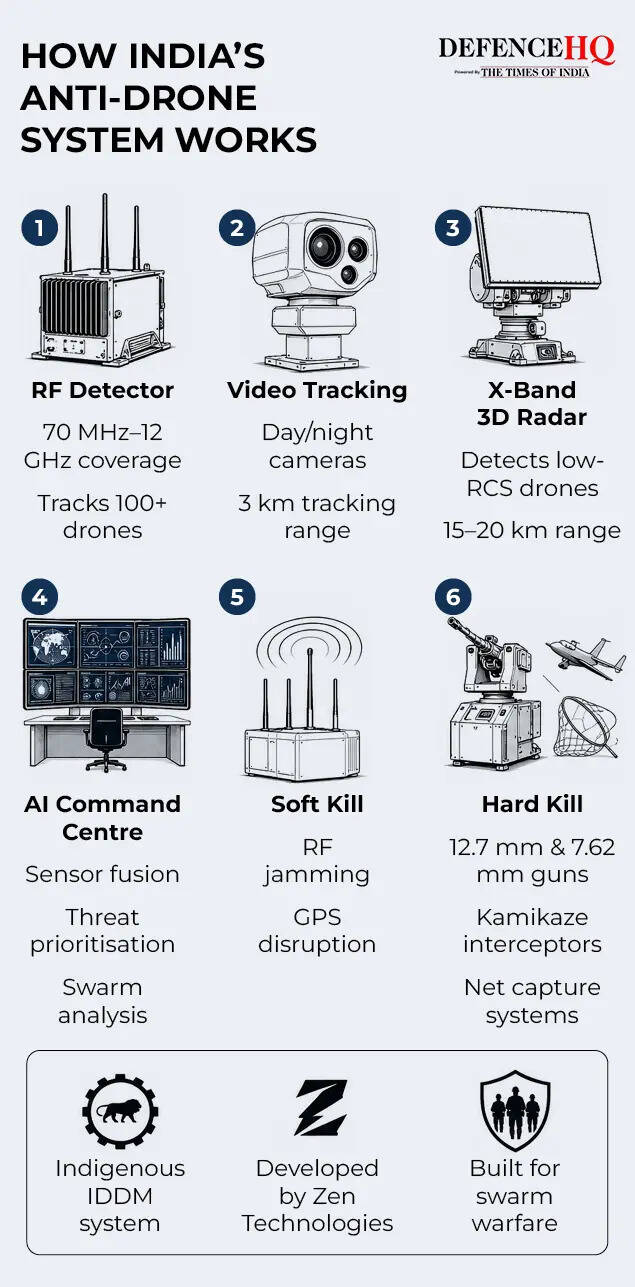
How India’s anti-drone system works
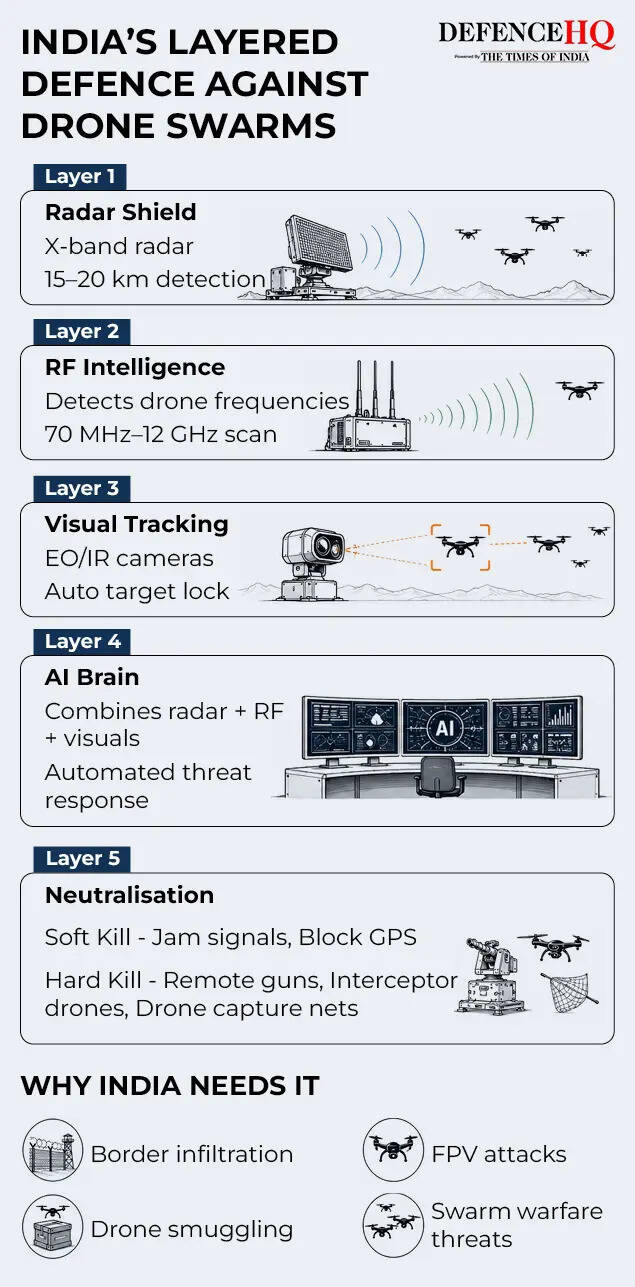
- RF-based drone detector: The RF-based drone detector scans frequencies between 70 MHz and 12 GHz to identify drone communication signals and reportedly track more than 100 drones simultaneously. This allows operators to detect hostile drones even before they become visually identifiable.
- Video tracking and identification: The Video-based Drone Identification and Tracking system uses day and night cameras mounted on an automatic servo-based positioning platform. The system is capable of capturing and tracking drone movement at ranges of up to 3 km.
- X-band 3D radar: The anti-drone shield also incorporates an indigenous X-band 3D radar designed to detect low radar cross-section drones and autonomous UAVs. Officials said the radar can detect smaller aerial targets at ranges between 15 and 20 km while providing precise azimuth and elevation data.
- AI-enabled command centre: At the core of the system is an AI-enabled Data Fusion and Command Centre that integrates radar feeds, RF signatures and visual tracking inputs. The command hub uses AI-based algorithms for threat classification, target tracking, sensor fusion, map-based monitoring and automated engagement prioritisation. According to the developers, this enables faster response times during swarm attacks involving multiple drones approaching simultaneously from different directions.
- Soft kill and hard kill options: The system includes multi-band RF jammers capable of disrupting ISM bands, GPS navigation signals and mobile communication networks used by hostile drones. These “soft kill” measures are intended to disable or disorient drones without physically destroying them. For direct interception, the platform also includes “hard kill” options involving kinetic neutralisation systems. These include remotely controlled weapon stations equipped with 12.7 mm and 7.62 mm guns capable of automatically aligning and firing at aerial targets. The platform can also integrate air-defence guns and kamikaze interceptors, while net-based drone capture mechanisms may be deployed for certain operational scenarios

About the AuthorTOI News Desk
End of Article
Tired of too many ads?go ad free now
Arsenal
- Missiles
- Tanks
- Guns
- Submarines
RS-28 Sarmat Satan II
Missiles
- RS-28 Sarmat Satan II
Russia
- Trident II D5
USA
- LGM-30G Minuteman III
USA
- RS-24 Yars
Russia
- M51.3
France
- Agni-V
India
- Hwasong-17
N. Korea
- RT-2PM2 Topol-M
Russia
- Julang-2
China
- Agni-V
India
- Agni-P
India
- K-4
India
- BrahMos
India
- Pralay
India
- Nirbhay
India
- Akash-NG
India
- Astra Mk2
India
- Rudram-1
India
- MR-SAM
India
- Iron Dome Tamir
Israel
- David's Sling Stunner
Israel
- Arrow 2
Israel
- Arrow 3
Israel
- Jericho III
Israel
- LORA
Israel
- Delilah
Israel
- Popeye Turbo ALCM
Israel
- Spike NLOS
Israel
- Python 5
Israel
- Derby
Israel
- Patriot PAC-3 MSE
USA
- THAAD
USA
- SM-3 Block IIA
USA
- SM-6
USA
- Tomahawk Block V
USA
- JASSM-ER
USA
- AIM-120D AMRAAM
USA
- BGM-109 Tomahawk Block IV
USA
- Shahab-3
Iran
- Emad
Iran
- Sejjil-2
Iran
- Kheibar Shekan
Iran
- Fattah-1
Iran
- Soumar
Iran
- Paveh
Iran
- Noor
Iran
- Khalij Fars
Iran
- Shahed-136
Iran
- Bavar-373
Iran
- Fateh-110
Iran
Russia
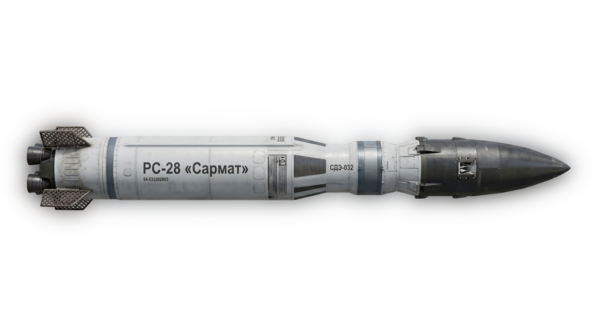
Missile
RS-28 Sarmat Satan II
Service Start
2023
Service End
Present
Range
18000 km
Defence Videos


Defence News

Defence |2 hours ago
What makes INS Kolkata formidable? Warship that foiled a piracy threat in Indian Ocean
Defence |2 hours ago
Tata, L&T and Bharat Forge shortlisted for India’s fifth-generation fighter project
Defence |4 hours ago
Swarm attack stopper: India's AI-powered anti-drone system with radar, jammers & hard-kill guns