
- News
- India News
- Cool summer can impact monsoon onset: Experts
Trending
This story is from May 6, 2023
Cool summer can impact monsoon onset: Experts
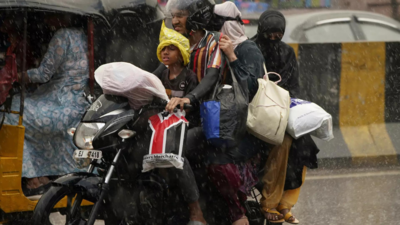
If the landmass of India tends to cool down during summer, as happened this year, the temperature gradient between the land and sea decreases. This can lead to a delay in the onset of the southwest monsoon over the Indian subcontinent, which normally sets over Kerala around June 1.

Dr M Rajeevan, former secretary of ministry of earth sciences, on Friday told TOI, “The pre-monsoon period in India, from March to May, is crucial in setting the stage for the southwest monsoon. The onset and progress of the southwest monsoon are affected by a variety of factors, including the sea surface temperature, land surface temperature and atmospheric conditions. These are a few of the parameters for forecasting monsoon onset and progress over India.”
Dr Rajeevan said a rainy pre-monsoon period in India and associated land cooling during March to May so far this year could delay the onset and progress of the southwest monsoon.
Dr Rajeevan said a delay in the onset and progress of the southwest monsoon might not affect the seasonal monsoon. “Warmer-than normal pre-monsoon temperatures tend to lead to an earlier on set and stronger progress," he said. India experienced an unusual drop in temperature this April, with the country seeing its coolest nights since the last five years, also, coolest and wettest days after 2020. The experts said conditions close to the onset (May) would have a stronger impact on the onset than March-April.
DS Pai, head, Environment Monitoring an d Research Center of India Meteorological Department (New Delhi), told TOI, “The onset and strength of the monsoon in India are determined by a variety of factors, including the temperature contrast between the land and ocean. Typically, the land warms up during the pre-monsoon or summer season, which helps to pull the monsoon towards the land regions.”
He s aid, “If the warming over land is insufficient during this period, it could hinder the process of pulling the monsoon towards the land region. This summer, there is significant moisture over the land. It will take time for the moisture to evaporate off the top soil. The top soil needs to be warm enough to pull the monsoon towards the land regions.”
Pai, however, added that the evolution of the thermal pattern over land surface and Indian Ocean leading to setting of monsoon flow was only one of the factors determining the monsoon onset. “The evolution of wind and convective patterns in the Asia-Pacific region are also important. A cyclone is also soon likely to form over the Bay of Bengal. This can play an important role in the evolution of thermal, dynamic and convective patterns, leading to monsoon onset over the region. The next few days would be crucial to determine the timing of the monsoon onset this year . IMD’s forecast on monsoon onset will be released soon, based on these parameters,” he said.
Dr Roxy Mathew Koll, senior climate expert from Indian Institute of Tropical Meteorology (IITM), Pune, told TOI, “Pre-monsoon temperatures can be one of the factors that can influence the monsoon onset. An El Nino can enhance the tropospheric temperature gradient by increasing the temperatures over Eurasia and thereby weaken the monsoon winds.”

About the Author
Neha MadaanEnd of Article
FOLLOW US ON SOCIAL MEDIA







Photostories

Hot Picks
TOP TRENDING
Popular Categories
Hot on the Web
Top Trends
Stock Market TodayBasit AliBrittany MahomesRavichandran AshwinBabar AzamKanpur Test Match RecordsUGC NET Result 2024Tirupati LadduIndia T20 WC SchedulePPF CalculatorBryonna Burrows Net WorthWomen T20 World Cup Points TableWomen T20 World Cup ScheduleIND vs PAK T20 WC MatchDiddyTop Management Colleges of IndiaLive Cricket Score
Trending Topics
GovindaNavratri Colours 2024Solar Eclipse 2024 TimesNavratri WishesGandhi Jayanti WishesDevara CollectionGOAT OTT ReleaseGandhi Jayanti 2024Rajinikanth Health UpdateNavratri HistoryDevaraGovinda NewsDevara Movie ReviewHealthy RaitasSwatantrya Veer SavarkarColdplay India tour 2025Upcoming Smartphones In OctoberAmazon SaleSony Bravia 55 inch 4k Ultra HD TVWordle Answer
Living and entertainment
Latest News
Zodiac Signs as Romantic Movie CouplesJapanese artist’s tribute to Indian classical dance formAnanya Panday unveils her Amol Palekar-inspired look in quirky BTS PICS from 'CTRL’Sanjay Dutt celebrates 'Gandhigiri', shares a scene from 'Lage Raho Munna Bhai'Women's T20 World Cup 2024: Teams, format, venues, defending champions and more FAQs answeredGovinda's bullet injury: Mumbai police not convinced with actor's version but rule out foul playGovt proposes to bring motorcycles under ‘contract carriage’ by amending MV ActHaircuts and colours to try out this PujoTriptii Dimri denies skipping the Jaipur event after allegations of charging an appearance feeWatch: Orry channels Aishwarya Rai in a hilarious tribute to Shah Rukh Khan and Amitabh Bachchan starrer 'Mohabbatein'Former WWE Champion Jeff Hardy talks about “addiction struggles”Qualifier Yash upsets second seed Manish at Fenesta Open'Scam marathon' under JMM-Congress-RJD rule 'biggest obstacle' to Jharkhand's development: PM ModiPopulation of Hindus & tribals declining in Jharkhand, says PM ModiWHO chief praises PM Modi on 10th anivarsary of Swachh Bharat missionNasa switches off instrument on Voyager 2 spacecraft to save powerAre 3 senior Karnataka mantris jockeying for chief minister's chair?Best Leather Wallets for Men in 2024: Timeless Elegance
Copyright © 2024 Bennett, Coleman & Co. Ltd. All rights reserved. For reprint rights: Times Syndication Service