
- News
- Elections News
- A tricky situation for all parties
This story is from April 4, 2019
A tricky situation for all parties
Parties have faced tough and unpredictable races here, especially since 1999, when AP Abdullakutty, then with the CPM, wrested the constituency from the Congress, by defeating five-time MP Mullappally Ramachandran by a margin of 10,247 votes.
Though it was a surprise victory, which gave him the pet name ‘Athbuthakutty’ (miracle boy), he stamped his mark on Kannur’s political history with a better performance in 2004, by defeating the same opponent, with a margin of 83,849 votes.
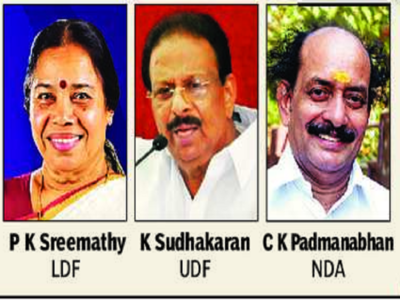
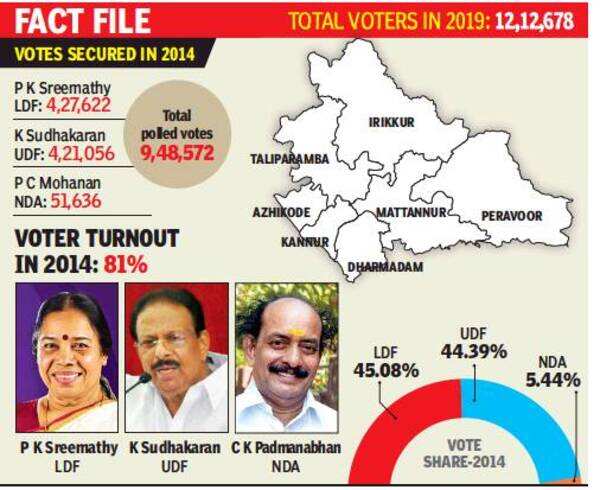
With Abdullakutty joining the Congress, the constituency also began to show signs of change. In 2009, Congress leader K Sudhakaran defeated CPM’s K K Ragesh by 43,151 votes. But he was not able to repeat the victory in 2014 as CPM’s PK Sreemathy edged past him by 6,566 votes. Of the total 9,48,572 votes polled (including NOTA, invalid and the votes that could not be retrieved from the EVM) Sreemathy got 4,27,622 votes and Sudhakaran 4,21,056 votes.
Incidentally, two namesakes of Sudhakaran together received 6,985 votes while 7,026 went in favour of NOTA. Moreover, the SDPI also managed to get over 19,000 votes, which again had an impact on the UDF’s performance, which was already rocked by internal bickerings.
Though the region will witness a fight between the same candidates, this time around, the scenario is different and there is better coordination among the UDF constituents.
The factors that favour incumbent MP P K Sreemathy are the development projects she has brought to her constituency over the past five years. The projects she mentions include, several centrally-aided schemes successfully implanted in the district and the development of Kannur railway station, which was recently revamped with a subway, lift and an escalator.
Also, Kannur being the home district of chief minister Pinarayi Vijayan, and having a well-oiled party machinery, the CPM hopes to repeat the victory. But since former district secretary P Jayarajan is contesting from neighbouring Vadakara, there is a concern whether the focus of the party machinery would shift as it is considered a more prestigious seat.
Of the seven constituencies, four – Kannur, Thaliparamba, Mattannur and Dharmadom - are with the LDF while the remaining three-Azhikode, Irikkur and Peravoor – are with the UDF. The LDF has a margin of over one lakh votes as per the assembly election data but the equations could change in the Lok Sabha election. Two assembly segments in Kannur-Thalassery and Koothuparamba-fall in Vadakara parliamentary constituency while the ‘red forts’ of Kalliassery and Payyannur are part of Kasaragod Lok Sabha constituency.
Though development issues find their way into the political discourse, the focus of the Congress’s campaign so far has been on political murder of Kripesh, Sarath Lal and M V Shuhaib.
Sudhakaran is hopeful that the stand the Congress took on the Sabarimala issue by playing the faith card would also fetch him votes. At the same time, he has promised to set up new educational institutions and create new employment opportunities, besides developing Azhikkal port, which might impress young voters.
Though the BJP has fielded senior leader C K Padmanabhan in the constituency, in the numbers game, the party is at a distant third position, managing to get only 51,636 votes in 2014 and the party’s aim will be to improve its tally.
Though nearly 65% votes are ‘compartmentalized’ political votes, the minority votes and the also the so-called neutral votes have a major role to play in Kannur, which have always thrown up surprises.

About the Author
P SudhakaranEnd of Article
FOLLOW US ON SOCIAL MEDIA
Photostories
Hot Picks
TOP TRENDING
Popular Categories
Hot on the Web
Top Trends
Haryana Election ResultNew UPI Transaction LimitHurricane MiltonRBI Monetary Policy MeetingWorld First Top 10 TrillionairesStock Market TodayKerala Lottery ResultElection Results 2024Biblical TreeJammu Kashmir Election ResultIsrael Hezbollah WarHardik SinghManagement Colleges of IndiaTop Medical Colleges of IndiaTop Engineering Colleges of IndiaTop Pharmacy Colleges of IndiaLive Cricket Score
Trending Topics
Navratri 2024 AshtamiBigg Boss Tamil 8 Contestants ListTP Madhavan DeathNavratri Colours 2024Sanjay Leela BhansaliDurga Puja 2024Bigg Boss 18 House PhotoDevara CollectionBigg Boss 18Deepika PadukoneShailesh LodhaDevaraColdplayNational Film Awards 2024Swatantrya Veer SavarkarColdplay India tour 2025Watch NFL Live StreamDress To ImpressCall Of Duty Black Ops 6Wordle Answer
Living and entertainment
Latest News
Hurricane Milton: Why Tampa area is so vulnerable to stormsBeard Trimmer with Titanium Blades: Style Your Beard to Perfection with Unmatched SharpnessTHE World University Rankings 2025: IISc Leads India , Check the List of Top 10 Indian Institutes HereA daughter lost without her father, old alliances: How NC came back with a bang in J&KAre HDFC Bank, Axis, Kotak a value buy or value trap for investors?Ethel Kennedy, widow of Senator Robert F Kennedy Sr suffers stroke in sleep, hospitalisedRanbir Kapoor's UNSEEN BTS pic from 'Shamshera' goes viralSum 41’s Deryck Whibley accuses former manager of sexual abuse in new memoirHyundai aims to raise up to $3.3 billion in record India IPOPrabhas starrer 'Kalki 2898 AD' gears up for its release in JapanMan declares income of Rs 9.6k, pays tax on Rs 43.5L after US earnings addedPatanjali Foods gets CCI nod for Rs 1,100-crore buyout of parent's home & personal care businessWho is Aniruddhacharya Maharaj? Know more about Pookie Baba’s life journey and net worthWill Allu Arjun be able to beat Prabhas in North America with Pushpa 2?'Vettaiyan' early and first review: Rajinikanth starrer has a good twist!Nagarjuna takes legal action against Konda Surekha; Records statement in Rs 100 crore defamation caseKarnataka Cong MLA booked for rape, kidnapping and criminal intimidationStunning images from space shows Hurricane Milton swirling over Earth
Copyright © 2024 Bennett, Coleman & Co. Ltd. All rights reserved. For reprint rights: Times Syndication Service