NEW DELHI: India has deployed 12 nuclear warheads in peacetime for the first time, signalling a significant shift in its nuclear posture, according to the latest assessment by the Stockholm International Peace Research Institute (SIPRI).
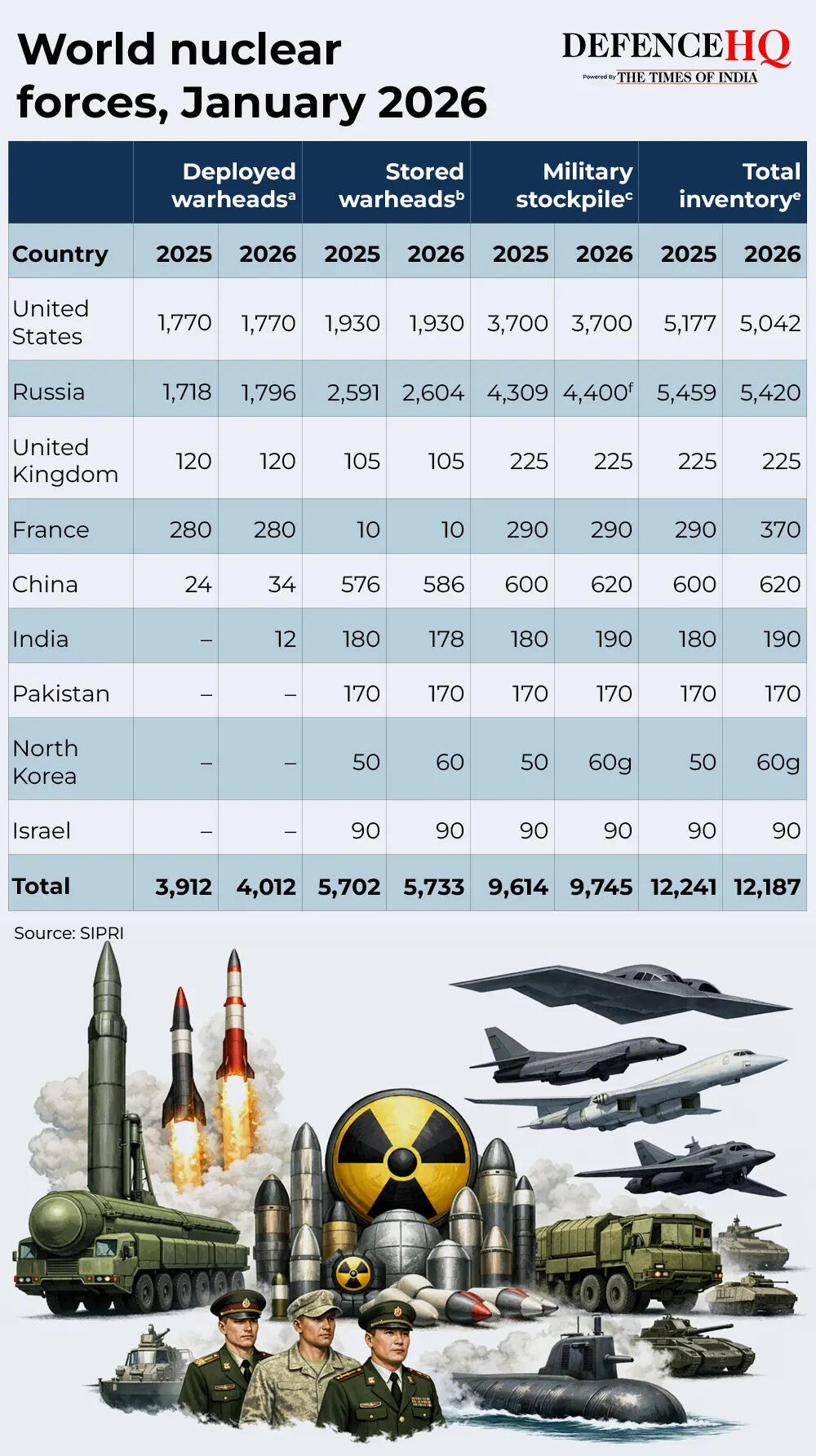
In its Yearbook 2026 released on Monday, SIPRI reported that India now possesses a total nuclear arsenal of 190 warheads, up from 180 a year earlier. Of these, 12 are assessed to be deployed, marking the first time the global arms watchdog has classified any part of India's nuclear arsenal as operationally deployed rather than entirely stockpiled.
190 Nukes: India's Nuclear Lead Over Pakistan Is Rewriting South Asia's Nuclear Arms Balance
The finding represents a departure from India's long-standing practice of storing nuclear warheads separately from delivery systems such as ballistic missiles during peacetime, according to SIPRI.
"It has long been assumed that India stores its nuclear warheads separate from its deployed launchers during peacetime. However, the country's recent moves towards placing missiles in canisters and conducting sea-based deterrence patrols suggest that India could be shifting in the direction of mating some of its warheads with their launchers in peacetime," SIPRI said in its report.
According to SIPRI's estimates, India had no deployed nuclear warheads in its previous annual assessments.
The latest report lists India with 12 deployed warheads and 178 stored warheads, bringing its total military stockpile to 190 warheads as of January 2026.
The report further stated that India "may have started deploying a small number of nuclear warheads on a single SSBN conducting occasional deterrence patrols."
The assessment comes amid India's steady efforts to strengthen its sea-based nuclear deterrent, considered the most survivable leg of the nuclear triad.
India has operationalised two nuclear-powered ballistic missile submarines, INS Arighaat and INS Aridaman, since August 2024. Both submarines are capable of carrying nuclear-armed ballistic missiles and have been cleared for deterrence patrols, according to information released by Indian authorities.
SSBNs, or nuclear-powered ballistic missile submarines, typically undertake long-duration deterrence patrols while remaining hidden underwater for extended periods. Their primary role is to ensure a credible second-strike capability in the event of a nuclear attack.
India maintains a No First Use nuclear doctrine, under which nuclear weapons are intended primarily for retaliation following a nuclear strike.
SIPRI's assessment suggests that the deployment of a limited number of warheads may be linked to India's growing sea-based deterrent capability and the operationalisation of its SSBN fleet.
The report also highlights India's broader nuclear modernisation efforts. "India is believed to have once again slightly expanded its nuclear arsenal in 2025 and continued development of new types of nuclear delivery systems," SIPRI said.
According to the institute, India's modernisation programme is increasingly focused on developing longer-range systems capable of reaching targets throughout China, although planning remains influenced by India's long-standing strategic rivalry with Pakistan.
While India has deployed 12 nuclear warheads, the figure remains modest when compared with other nuclear powers.
SIPRI estimates that China currently possesses 620 nuclear warheads, of which 34 are deployed. This is only the second year that SIPRI has categorised China as possessing operationally deployed nuclear weapons.
China's deployed warheads increased from 24 in 2025 to 34 in 2026, according to the report.
The institute said China is expanding its nuclear arsenal faster than any other country.
"SIPRI estimates that China now has around 620 nuclear warheads. China is expanding its nuclear arsenal faster than any other country and showcased several new nuclear systems during its 2025 military parade," the report said.
According to SIPRI, China has loaded hundreds of missiles into three major missile silo fields in northern China while continuing construction of additional silo complexes in the eastern part of the country.
The report added that China could potentially possess at least as many intercontinental ballistic missiles as either Russia or the United States by the end of the decade, depending on how Beijing structures its forces.
Despite China's rapid growth, SIPRI noted that even if Beijing surpasses 1,000 nuclear warheads by 2030, its arsenal would still be only about a quarter of the current Russian and American stockpiles.
Russia continues to maintain the world's largest deployed nuclear force.
According to SIPRI's data, Russia has 1,796 deployed nuclear warheads, compared with 1,770 for the United States. Russia's total military stockpile stands at approximately 4,400 warheads, while the United States possesses around 3,700 usable warheads.
Together, Russia and the United States account for roughly 83 per cent of all military stockpiled nuclear warheads globally, SIPRI said.
"Russia and the USA together possess around 83 per cent of all stockpiled nuclear warheads (i.e. useable warheads)," the report stated.
The institute noted that both Moscow and Washington continue extensive modernisation programmes, although both face technical and financial challenges.
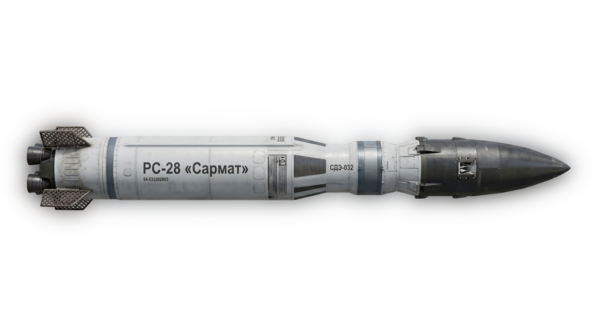
Russia's modernisation efforts have reportedly encountered setbacks, including another failed test of the Sarmat intercontinental ballistic missile during 2025, according to SIPRI. At the same time, the report said Russia has continued work on several advanced nuclear systems and has begun constructing infrastructure in Belarus for the dual-capable Oreshnik intermediate-range ballistic missile.
The United States is pursuing a sweeping nuclear modernisation programme, but SIPRI said planning and budgetary pressures continue to affect timelines and costs.
At the global level, SIPRI warned that nuclear arsenals are expanding after decades of decline.
The nine nuclear-armed states, namely the United States, Russia, the United Kingdom, France, China, India, Pakistan, North Korea and Israel, all continued modernisation programmes during 2025 and most introduced new nuclear-capable systems, according to the report.
SIPRI estimates that the global inventory stood at 12,187 nuclear warheads in January 2026. Of these, approximately 9,745 were in military stockpiles available for potential use.
Around 4,012 warheads were deployed with missiles and aircraft, while between 2,100 and 2,200 remained on high operational alert, primarily in Russia and the United States.
The report noted that China and India "may now occasionally deploy a small number of warheads mounted on missiles during peacetime."
SIPRI Director Karim Haggag warned that growing reliance on nuclear weapons could increase global risks.
"Influential voices, including some world leaders, are advocating nuclear weapons as a guarantee against attack by a hostile state. But making national defence and security strategies dependent—or more dependent—on nuclear weapons could significantly increase nuclear risks," Haggag said.
"The dangers associated with nuclear weapons are growing due to advances in weapon technology, the breakdown of nuclear arms control and heightened geopolitical tensions, among a range of other factors. At the same time, world events—not least the outbreak of conflict between nuclear-armed India and Pakistan—are challenging nuclear deterrence logic."
Hans M. Kristensen, Associate Senior Fellow with SIPRI's Weapons of Mass Destruction Programme and Director of the Nuclear Information Project at the Federation of American Scientists, said the trend points towards a renewed arms race.
"The evidence is growing that the nuclear weapon states are sidelining, and even walking away from, their disarmament commitments and are instead flexing their nuclear muscles," Kristensen said.
"By reaching for nuclear solutions, states are creating new risks and fuelling arms-race dynamics."
The report comes at a time when the global nuclear arms control framework is under increasing strain. SIPRI noted that the 2026 Review Conference of the Nuclear Non-Proliferation Treaty concluded without a final consensus document, marking the third consecutive review conference to end without agreement.
Against this backdrop, India's deployment of 12 nuclear warheads marks an important evolution in its strategic posture, even as its operational arsenal remains far smaller than those of China, Russia and the United States. The shift nevertheless indicates a gradual movement towards a more operationally ready nuclear deterrent centred on survivable sea-based forces.