After a long pause of nearly two months in hostilities the Iranian regime fired eleven missiles at Israel. The Iranian missile barrage is said to be in response to Israeli strikes on Hezbollah targets in the southern suburbs od Lebanon's capital Beirut. The Israel Defence Forces (IDF) said it intercepted all the missiles and retaliated by carrying out airstrikes on military targets in western and central Iran.
The failed Iranian attack has once again put the spotlight on Israel's air defence set-up. The Israelis have designed their comprehensive and layered air defence network with different types of weapons that are designed to take on different types of threats ranging from simple kites tied with explosives all the way to ballistic missiles.
Israel's Multi-Layered Air Defence ShieldTel Aviv has invested heavily on building one of the world’s most sophisticated and comprehensive air defence networks. Rather than relying on a single system, it fields multiple layers of defence systems for various types of targets at different ranges. Together, these systems form a protective umbrella over Israeli cities, military bases, and critical infrastructure.

Israel defence systems
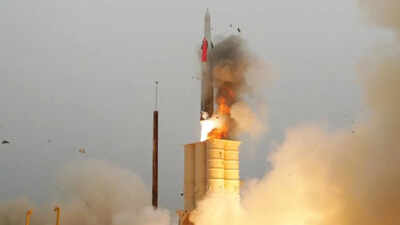
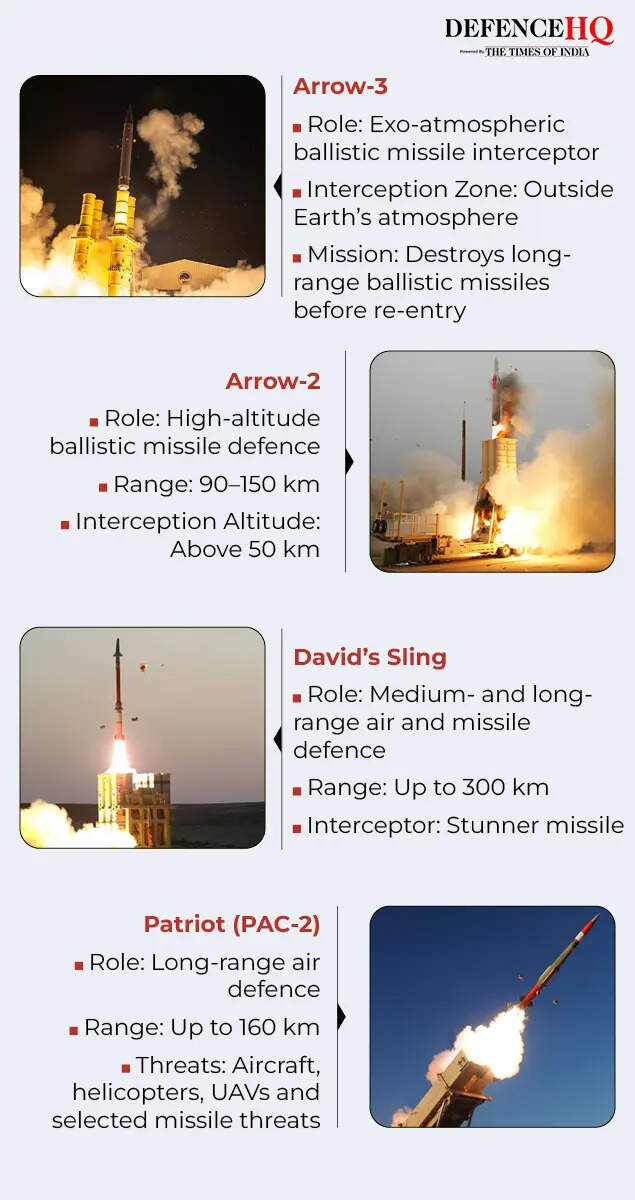
serves as the first line of defence, Arrow-3 is designed to intercept long range ballistic missiles outside the earth’s atmosphere. It intercepts the incoming threats at an altitude of more than 100km in space. It is capable to engage multiple targets simultaneously and destroy them before re-entering in earth’s atmosphere.
Arrow 2: this system is designed to intercept ballistic missiles within or near the earth’s atmosphere. It acts as the second layer of defence network. Together with arrow 3, the two systems form the backbone of Israel’s strategic defence capability. It can intercept targets at ranges of 90–150 kilometres and at altitudes above 50 kilometres.
David’s Sling: Positioned between the Arrow and Iron dome, It is designed to intercept wide range of aerial threats, including tactical ballistic missiles, cruise missiles, aircraft and drones. It uses Stunner missile for interception at the ranges of up to 300 km, according to Washington DC based think tank CSIS.
Patriot: One of the primary long-range air defence systems, the MIM-104 Patriot is protecting the skies of Israel since 1990s. acquired from United states, it is designed to defend against aircraft and later adapted to counter drones. It can intercept a target at a range of up to 160 km with the speed of above Mach 4.
Israel defence systems
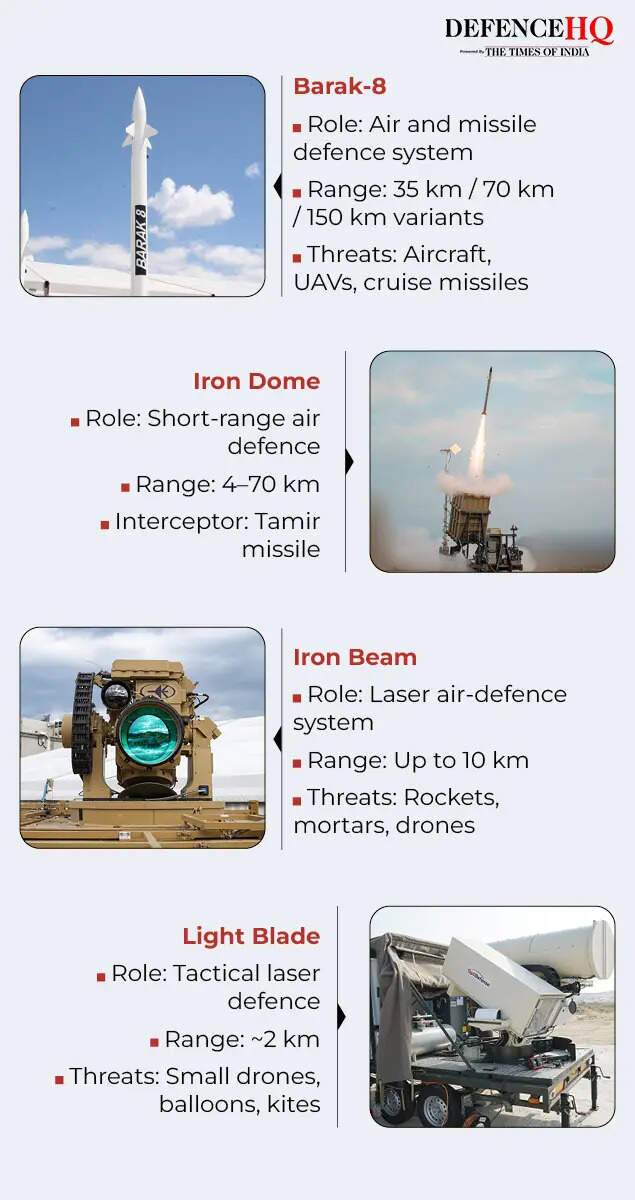
It serves as a critical component of country’s naval air-defence, deployed aboard Israeli navy warships. Barak is designed to engage aircrafts, UAV’s cruise missiles, and anti-ship missiles With its different variants it can intercept a target a range of up to 150 Km. It Protects the strategic offshore assets such as gas platforms from wide range of aerial threat.
Iron dome: The most recognizable component of Israel’s air defence network, the iron dome counter the constant threat of short-range rockets, artillery shells and motors from Hamas and Hezbollah. It fires Tamir missile and intercept targets at range of up to 70 km. Since its deployment in 2011, the system has intercepted thousands of projectiles fired towards Israeli cities and critical infrastructure.
Iron Beam: Representing the next-generation of air- defence technology, iron beam is Israel’s first high energy laser weapon. It is intended to intercept low-cost aerial threats including motars, drones and UAV’s using concentrated laser rather than missiles. It can destroy the incoming targets at the range of up to 10 km. The system addresses one of the biggest challenges in modern air defence, cost. While conventional interceptor cost thousands of dollars per launch, iron beam can engage targets at a fraction of that cost.
Light Blade: It is the shortest end of Israel’s air defence spectrum; a tactical laser system developed to counter small aerial threats. It can target incendiary ballons, kites and small drone at a range of 2 km.
From Arrow-3 intercepting long-range ballistic missiles beyond the atmosphere to Light Blade targeting small drones and incendiary threats at close range, Israel multi-layered air-defence network demonstrated why it is considered among the most advanced in the world.
Working together, these overlapping layers provide Israel with multiple opportunities to detect, track and neutralise incoming threats before they can reach their targets.